Showing posts with label How to get started. Show all posts

Tuesday, 23 April 2013

Weedless jigging rig for cod and pollack

This time of year is prime for the spring cod run in the north east, before the dreaded May "bloom" kicks in and kills the fishing somewhat. If you've visited this blog before or searched for cod rigs, you'll know that I gave up using the traditional pirk plus hokkais combination some years ago.  Even when you rigged the pirk with an assist hook, you still ended up with quite a bit of tackle losses as a result of fishing close to the bottom, especially if on a fast drift or over a big swell.
Lots of different ways to store a pirk
plus hokkai rig - simplest is just to wrap
it round and tie it with a rubber band.

The bog standard pirk plus hokkais rig used all
over the north east for cod.


Tackle losses are to be expected in such conditions, but after I replaced the pirks with a big jelly shad (5") and a heavy lead head, I lost far less tackle due to the shad tending to rest on its head or side when it hit the bottom, so the exposed hook had less chance to get stuck into anything.

I also found the big shad attracted a better stamp of fish.  This fish had a few goes at a Storm Giant Jigging Shad before ending up in the yak.  Sometimes if you feel a nip, it's wise to reel in and check they haven't bitten the tail of your jelly lure, thereby rendering it useless.
Unfortunately, although we lost fewer rigs overall, that improvement tended to be offset by the far greater initial cost of the big shads compared to a traditional pirk.  Even with home cast lead heads and cheap jelly bodies, we still weren't curing the problem because no matter how well designed the lead head is, if the hook is exposed, there is every chance that you come up against the kayak fisherman's worst enemy: the pot rope!  Even if your fishfinder shows these up in mid-water, on a fast drift / tide it can be hard to get your tackle up in time to avoid them and the fishfinder doesn't always pick them up when they're close to the bottom.
Homemade shad heads: expect heavy tackle losses and arm yourself with enough for the year!
My plan this year is to go with all jelly lures and by rigging the whole lot weedless, to hopefully end up with a snag proof rig that'll avoid the bottom snags as well as avoiding the pot ropes.

First stage is to look for a replacement for the hokkais.  Hokkais are simply a better form of the old fashioned mackerel or cod feathers.  Yes, they have glowing beads and a few glittery bits, but basically it's the same idea that is very difficult to rig weedless.  Luckily, over the last decade or so, ultra light rock fishing has become popular in Japan (and here too).  This has meant we now have an excellent choice of tiny paddle tail jelly lures that can be rigged weedlessly.  These are the Reins Rockvibe Shad 2" UV Super Glow B63 and the slightly larger 3" Neon Wakasagi:
These are from the Reins freshwater range, with the right hook they can be rigged weedless.  
So that's hopefully going to cure the pot rope snags.  It's true that these won't have the resistance that hokkais do, but even hokkais get torn up after a few mackerel.  The tiny paddle tails are cheap (10p each) and easy to replace.

Now to cure the shad problem.  I still want a big paddle tail, but there's not much out there that can be easily rigged weedless.  But early last year, my prayer's were answered when the first "daddies" of the Fiiish Black Minnow range came on sale.  At 16cm, it's quite a long lure (a near perfect launce imitation in my opinion), and with a maximum head weight of 60g it remains to be seen whether they'll keep their depth in a really big tide or an uptide drift: 
The big daddy of the Fiiish Black Minnow range, 160mm with a 60g offshore head. The perfect launce  imitation?
As we know big launce love baby sandeel and sandeel imitations (I frequently catch them on hokkais), it makes sense to rig them so that it gives the appearance of a launce chasing a smaller sandeel.  Generally it's the bottom sandeel imitation that the pollack grab, while the bigger cod nearly always hit the bottom shad.  I stick to just three sandeel imitations, any more than that and you're asking for trouble when the mackerel hit it in numbers.

That's it!  Hopefully a cod and pollack jigging rig that is snagproof on the bottom and against pot ropes.  Of course if you're travelling at pace, I would still expect the tiny paddletails to snag up against a rope as the soft lure only barely covers the hook point. We'll see. I'm confident it'll catch, and I'm confident it'll be better than the rig I was using last year, where every hook on the shad or hokkais was exposed.

And that's what it's all about isn't it?  Trying to do things better, to make it easier to catch more fish.

Tight lines for the coming season!

Friday, 22 February 2013

VHF radios and sea kayak fishing PFDs

After three seasons, my Stolhquist Fisherman PFD gave up the ghost.  Every zip on every pocket had stopped working, rendering the pockets so useless that I cut the flaps off one of them. But the inner netting pocket is too small to keep anything useful in and is obviously exposed to the wet, and I needed somewhere secure to keep my Aquapac-protected phone plus fishing tools.  So once again I am heading to the marketplace for a decent sea kayak fishing PFD.

Now we have many things to be thankful to the Americans for, but just occasionally the size of their internal market means that the big global producers of kayaking clothing and equipment tend to focus on what will sell well for their American customers.  In the case of kayaking PFDs, this means that the majority are designed for either for sit-in kayaks (meaning they have a low back), or inland sit-on tops (SOTs) kayaks, as high performance sea worthy SOTs remains something of a niche market in the US.

This means we have companies like Stolqhist and MTI producing angling PFDs that are intended principally for fly fishing on inland waters.  Which is fine, but those products rarely transition well to sea kayak angling.  For example, MTI like to place a lash tab right above their pockets, making it difficult to attach a handheld VHF unit there.  This is not a problem if you are fishing inland lakes as you're unlikely to use a VHF radio.

However at sea, a handheld VHF unit is essential for safety and staying in contact with other boats in the area.  Most VHF units come with a clip to attach to a lash tab, but the positioning of that tab must allow easy access to the radio. It should keep the radio close to your mouth, so that no bending down is needed to use it. Ideally - in extremis - a waterproof VHF unit should remain usable even if you're in the water and the positioning of the radio must not place the radio so low that it might catch or snag any rigging on your kayak if you need to attempt a re-entry.
Struggling to speak into a badly positioned VHF radio.
The radio would be practically underwater if you took a spill.
That last point is crucial to safety.  If you've been sea kayaking for some time, you know that the chances of you coming out of your kayak at sea are higher in bad conditions. With wind and waves battering you and your kayak, you don't want to waste time to fiddle about trying to take off your VHF unit because it keeps snagging on your anchor line or some deck rigging as you try a re-entry. Besides, even if you do take it off, what next?  You're trying to keep your head above water and climb back onto a bucking kayak. Perhaps the kayak is upside down. Whatever. You certainly don't need any extra hassle. Remember that most people are only capable of 4 or 5 re-entry attempts before they get too tired and have to rest. I've had that happen to me and it's very unpleasant, you start to wonder if you'll ever get back on your yak.

You want that VHF unit somewhere secure, well out of the way, preferably up near your collarbone where it won't catch on anything as you clamber on board. Unfortunately, designing PFDs to make it easy for SOT kayak users to easily re-enter their craft after a capsize doesn't appear to be high up on the agenda of most companies.
The Kokatat Bahia Tour has a lot of front bulk, made worse if you attach a VHF unit to point furthest from the body, where it hangs vertically making the aerial prone to catching things.
A case in point is the Kokatat Bahia Tour PFD.  This PFD has just one lash tab, placed low down at the furthest point from the body, making it unsuitable for a VHF unit.  With most of the buoyancy in high back PFDs being in the front, they can be bulky there making re-entry difficult. Given that the higher a hand held unit is the further its signal will travel, it seems obvious that the lash tab position on the Bahia Tour is going to reduce the radio's effectiveness and just makes it awkward to use.  This rather thoughtless lash tab placement is unexpected from a manufacturer with Kokatat's reputation and spoils what would otherwise be a good PFD.
The Kokatat Bahia Tour's single lash tab.  How about giving us another one Kokatat?  :-)

Time for a change?

PFDs are made for many different aspects of kayaking.  White water, touring, recreation and angling.  In theory there are several top end sea touring PFDs (for example the Palm Kaikoura) that would be well-suited for sea kayak fishing, but unfortunately nearly all of them have low backs as their main markets are for sit-in sea kayaks, not SOTs.  Low back PFDs are less comfortable to wear in the high-back seats that are commonly used with SOTs.

In fact Palm are another case in point. While they have the well specified Palm Kaikoura as their top of the range touring PFD (shown below left), their high-back touring model suddenly comes down in specification (the Taupo, shown below right). Hmmm, no lash tabs at all on the Taupo? Nope, 'cos people who use high back PFDs don't need 'em!
Pam Kaikoura: lash tabs in abundance...
Palm Taupo: hey, where'd the lash tabs go?
The fact that SOT kayak users are considered second-class citizens in the kayaking world is understandable, as they came from a recreation background, i.e. they're not serious kayakers.  But that view is rapidly becoming out of date and it's high time for a change in the manufacturers' thinking.  These days, high performance glass and carbon fibre SOTs that are purpose built for angling are gradually getting more market share (with the exception of the US, where plastic remains king).  These new kayaks are intended to be paddled long distances and are just the sort of craft that can take you well off-shore in conditions previously only tackled by sit-in sea kayaks.  But even in the "plastic bath tubs" that many kayak anglers start off using, it is possible to get some distance off-shore and to experience challenging sea conditions.  As kayak anglers, we really need PFDs to match our hobby's requirements and where we can now fish.

I'm not advocating "rough conditions" sea kayak angling, but do you want to be out there with a "recreational" PFD when conditions get bad? Is your emergency strobe visible? Can you quickly change channel on your VHF if asked to do so? Could you access it if you were turned overboard? Is there a D-ring that would assist you being winched up to a rescue helicopter?

When I'm fishing at sea in my kayak, my fishing buddy can be anything up to a mile away from me.  Our VHF radios are always on, if the weather's a bit iffy then we're on channel 16 listening out for coastguard weather notices or warnings, but if the weather's fine we keep it on channel 12 and keep each other informed about what's happening via the radio. Things can change quickly when your at sea, not least the sudden appearance of fish!  You need rapid easy communication with your fellow kayakers and any nearby boats, and a VHF radio is the essential piece of kit for sea kayak fishermen to do that.

My essential feature list for a sea kayak fishing PFD

  • Front lash tab for VHF radio placed high up to facilitate frequent use and channel change.  
    • Lash tab preferably slightly angled to try and minimise VHF aerial from catching on things as you re-enter the kayak.
  • Rear lash tab for emergency strobe light, positioned to be accessible over the shoulder.
  • Solas reflective panels on front, back and top of shoulders.
  • Big splash-proof front pockets.  
  • High back design, with plenty of ventilation for hot weather kayaking.
  • Strong rear D-ring for rescue.
  • Not too much front bulk.

You would think that feature list would be easy to find but it isn't!  If you have any sea kayak fishing PFD recommendations or comments, please let me know.

Thursday, 31 January 2013

Interview with Brett Challenor of Stealth Kayaks, South Africa.

Part 1.

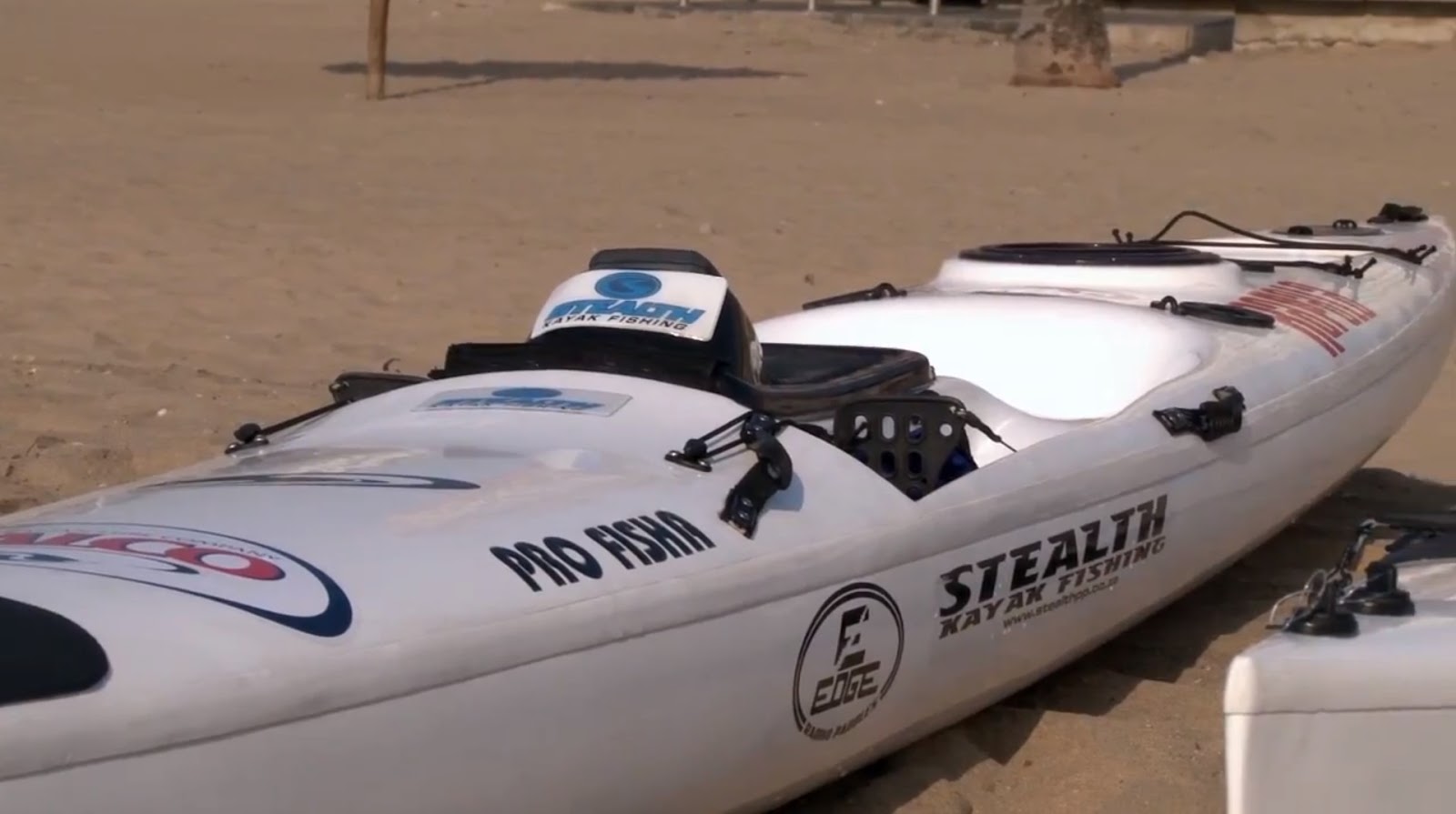
Finally here is the long awaited interview with Brett Challenor, the guy responsible for the new Pro Fisha 475 from Stealth Kayaks, a super lightweight purpose-built fishing kayak that's generating a lot of excitement here in the UK, with the first container load due to arrive on these shores in March.  


As someone who's just ordered the big daddy of the range, the 575, I had a whole bunch of questions I was dying to ask about Stealth's design philosophy, but I wanted to reach out to others who might have more general questions about fibreglass kayaks and their design, so I threw it out there for contributions from the Angler's Afloat forum. Naturally they were only too happy to contribute! We begin by finding out a little bit about Brett's background, how Stealth was formed and where the company is now.


Brett showing off with another tiddler.
How did you start building kayaks?

Stealth was started over 17 years ago when I was working in my fathers boat building factory. He has been a fibreglasser and boat builder since he was 16 and is now almost 50 years in the business. At the time I was racing competitively in the lifesaving arena, competing in Australia and racing for South Africa. It was too expensive to import my own racing surf ski from Australia, so I thought why not make it myself and so Stealth was born. I went over to Australia and learnt how to build racing surf skis by working in a factory there for 3 months.


I then returned home and started my dream. For the first three to four years I only made one type of racing ski. Because I was racing for South Africa and winning a lot of the races, the business was easy as everyone wants the winning craft if you know what I mean. A few years later my Dad sold out of his boat building factory and joined me in the development and growth of Stealth performance products. We branched out into the fishing market and have never looked back. My Dad and I are now a great team, with his years and years of fibreglass experience and my understanding of what makes a ski work and perform, we now design and develop all our craft on CAD and then cut prototypes on a CNC machine followed by accurate plugs and end products. I think we now make possibly the world's finest fibreglass fishing kayaks.


For most kayak anglers in the UK, cost has always been a barrier and most start out with cheaper, plastic kayaks.  What advantages could you expect when upgrading to fibreglass from plastic?

Look, er, I'll give you a breakdown. When we started first started exporting to Australia we had a very similar thing. Especially as one or two brands are made over there, but what the guys quickly worked out is that, and it takes a bit of time, is that a fibreglass kayak, a fishing kayak, has been designed as a fishing kayak and it has hatches for a reason. Things are put in a place because functionally that's what we find is the best thing for the kayak. Whereas the majority of your plastic kayaks are recreational kayaks, for paddling down a river or whatever...

Yeah, ok, let's say I've got a dedicated plastic fishing kayak...

Recently the plastic kayak manufacturers have started to realise how big the fishing market is and have started to produce some specific designs for fishing. But they're not really what the guys need and use here in South Africa, where we have so many different launches. Here you might see one plastic kayak to every forty fibreglass kayaks.

But why is that? Is it just a performance factor?

Yeah, it's like riding a road race on a mountain bike. You'd like to be competitive, but you can't, if you know what I'm saying. You'll never get a plastic kayak to perform like a glass kayak. You've got a lot of glide with a glass kayak. It glides, it keeps going. A plastic yak stops when you stop. It's a lot harder to paddle. If you spend 5 hours on the water, and you paddle a glass kayak you'll be tired. If you paddle a plastic kayak for that time you'll probably need to sit down and rest for an hour! That's sort of along the lines to what we've always said. There is a market for a plastic kayak, but the guys who are looking for the performance, for kayaks that are easier to paddle, easier to manoeuvre, bit more customisable, glass is way ahead of plastic.

What are the main disadvantages with glass?   

Nothing really, you've obviously got to look after it a little better than a plastic one.

Well that leads to the next question, which is how durable is glass?

The way we make them these days, it's very durable. We had a customer who came in today, landed on the rocks, and it was just what we call a gelcoat (the colour). We just had to sand that back, respray it and polish it. It looks the same again. The technology that we've developed with the Pro Fishas is so advanced that we can make a really strong kayak, but it's also really light. So the durability is very, very good.

What about UV damage?  Is there any susceptibility for fibreglass?

Er, no.  Fibreglass will fade in time.  But if you want to compare fibreglass to plastic in terms of UV damage, I honestly believe if you left a plastic kayak in the sun it would do more damage to a plastic kayak over time than it would to fibreglass one.  Plastic starts to get brittle and takes a bit of strain.

OK, I've got a question from forum user andym: Can glass be repaired easily or does it need to be taken to a specialist? 

It can be repaired very, very easily. Fibreglass is just a piece of material, you put what we call resin on it, and it's a patch like that. It's very simple. Obviously the specialists get you a very good finish. It's bit like a dent in your car. You can panel beat it, but you can't hide the dent. The specialists can do that and get you a really good finish.

How customisable are glass yaks?

They are very customisable within the realms of what you've designed, for example in our case with Pro Fishas we've obviously developed and designed what we know has worked with our customers, whether that be offshore or locally. There are certain things you can do, but the majority of it needs to be done when it's manufactured and not afterwards. I'm talking about extra handles and things like that. You know, you need aluminium paper, something sort of strengthening, something strong. Otherwise if you just put a hole in it for a handle in the kayak, it will eventually pull out, as the glass is thin. But plastic is just the same. Look, if you're putting rod holders, things like that, there's no problem because you're cutting a hole. It's just if you're putting in screws, things like that [that require strength].

A kayak can’t be all things to all men.  What are the essential trade-offs in kayak design? 

Mmm, that's quite a debatable topic! In our case, if you want a kayak that has speed, or you want a kayak that rides a wave better, or you want a kayak that's really stable, you can't put all that in one kayak. No matter what you do, you can't. That's why, I think, that's what we've done with the 575, the long kayak, and that's what we call the speed machine. Because in kayaking, the longer the kayak, the faster it goes...
Plenty of waterline makes for a fast kayak.
why is that? I always wondered why...

Your waterline length. The more boat you have in the water, the easier it is to keep it going. You look at those racing powerboats, they're all long and thin. You know, the more waterline they can get in, the faster it can go. But then obviously you've got to have enough rocker design in them so that they go over the waves and doesn't plough through them. So what we did then with the 475, is say our customer there isn't looking for flat out speed, he wants slight better performance as well as the speed, so all we did was we shrunk the kayak and gave it a little more rocker, and that allowed the kayak to surf the waves better, didn't sacrifice the speed. Shorter the kayak, easier it is to turn.

That's why you see a lot of very short, plastic surf kayaks?

And that's why you see a lot of short plastics, as they don't have a rudder, so you put your paddle in and turn it. When it goes longer, the paddle can't turn and that's when you need to start putting rudders on.

You produce several designs for different conditions, could you go through the range for me and explain the thinking behind them? 

Sure no problem. The Supalite was the first ever range of kayaks we ever designed. I started making those in 1998. It developed from an old life saving rescue craft, where it's wide and flat, and we used to lay a patient on the front when you rescue them.

Oh wow, fantastic!

[laughs] And when we were bored, we used to take our fishing rods and go fishing!

Excellent...

And then we realised we needed somewhere to hide our fishing rods, because launching through the surf in South Africa you need to protect your fishing rods, so then we put hatch inside it, and that traditional shape stayed, purely because that shape can really surf a wave. Our Supalite, I can surf that kayak pretty much like a surf board, it's got that shape. The downside is that it's a bit slow, it's a bit like a plastic kayak, it's hard to keep it going, and it's hard to paddle, but the advantage is that it's got a rudder system, it can turn and surf a wave very nicely, it's got steering and you can control it. The three kayaks in that range are obviously purely by size of person.

So what was the next kayak after the Supalites?

After the Supalites, we came up with the Evolution range. We wanted a slightly faster to paddle kayak. That's where I put my knowledge of surf ski racing in, and said well, let's try and combine the stability of a fishing kayak with the instability of surf ski, and give it the same sort of design so that it paddles fast and that it's easy and everything. And we did that with the Evolution range, we made a much faster paddling kayak that has all the stability, all the features of a Supalite.  
The popular Evolution 465, kitted up and ready to go.
And yeah, we thought that was going to be the answer! But what actually happened, as people starting customising their skis, and wanting more and more, that range actually became very difficult to make it as light as possible, unless you only made it out of very fancy materials. So that's when the Pro Fisha range was launched. We started with the Fishas, which were a hybrid surf ski / fishing ski. It had a very small hatch to keep it light. They were for the client who said, "hey, I just wanna go for a paddle, if I put a rod out and catch a fish, it's a blessing!"

So it started out as a kind of minimalist fishing kayak?

Yeah! And it worked. We had a lot of guys in Australia who were buying them. And then, we found there were some guys who said "I don't want to use it as I want to take more than one rod". So then we took a step back, and said maybe we should design a fishing ski that's got the speed of a surf ski, the stability of a fishing ski, it's got a small hatch which is enough to take what you want, but which is made out of above average materials that keeps its weight down. Which is pretty much what we did. We converted what the Fisha range was, into something with an extra hatch in with a rod shoot that goes up to keep the weight down, and then we used the CNC machine and our CNC technology to design the kayak as light as possible. As I say, not too expensive, without using really expensive materials, but unfortunately to keep the weight down we had to convert to resins, like epoxy resins and specific core materials. And that's really where the Pro Fisha came from.
The new Pro Fisha.
Do you mean "unfortunately" from a price perspective?

The epoxy resin we use is obviously way way stronger than a polyester resin. It's just a little more difficult to work with, but the process that we've developed allows us to use it, so you get a far stronger resin system. And obviously the fibreglass that we're using, we've upped that a bit, the specific core materials that we've imported, that we use within that kayak to keep the weight down make it very, very strong. That's basically how that design came about.

Did you intend this range of different kayaks to be generic across the world or are they specific to South African conditions and launches? 

Er, well I came from spending a lot of my time overseas racing, when I was racing for South Africa, so from being a paddler. And I developed the business from a business that targeted [kayak] racing products, to a business that was more recreational, and obviously kayak fishing. I realised that if you're going to make fishing kayaks... the Supalite range is a wonderful range for South Africa, but it doesn't suit the overseas market because they're not taking on the surf like we do everyday. There, the sea stands up and the guys don't want to go kayak fishing! Australia's exactly the same, there the guys try and find as protected a launch as possible.

That's exactly what we do in the UK as well...

Yeah, so we realised we needed to find a range that suited our overseas market as well, and that we obviously identified that the Evolution range needed to be just a bit lighter, bit more manageable as well, leading to the Pro Fisha.

Once you're past the first few breakers, what helps a kayak handle a rough sea?

Obviously your stability is your biggest factor...

What about hull shape?

Yes the hull shape, you've got to have a really nice flat area underneath. Then what we call your rails, or the edges of your kayak, where it turns up towards to the sides. If you can roll your rails, that's the terminology we use, it gives you a lot more stability. The sharper your rails are, if you have a sharp rail, what it'll give is, you think it's more stable, but it's false sense of stability. What I'm trying to say with a very sharp rail, once you go over the edge, it'll turn over very easily. 

It's the loss of secondary stability?

Yes, it's like balancing a box. If you go over that edge, the box will fall over. If it has rounded corners you can right it to the middle again.

What about length, is that factor in rough seas? Advantage or disadvantage?

The length is more your speed. In a very big big wind, a shorter kayak will be easier to turn around in the wind, but the longer will have extra speed, so it'll be easier to paddle into the wind and keep it going if you need to, so it's a trade off, it really depends on the conditions.

What does rocker mean and what's it's significance to yak design? 

The rocker is the banana shape. If you put a pen on the table, and it's got no rocker, both the front and back of the pen touch the table. If you bend the pen, so that the ends point upwards towards the sky, that's what we call the rocker.
Rocker design in practice: punch through or go over?
What does rocker give you?

The rocker gives you the ability to surf a wave a lot easier. If you come down a wave, a kayak with more rocker means that the tail can dig in more, and the nose can lift easier, which means you can use the rudder to steer it a lot easier. Whereas with a longer kayak, you've got to have a little more speed to be able to turn it like a shorter one.

Does it affect how easy it makes the yak to paddle into waves from an oncoming wind?

Yes. When you launching in the surf, the kayak with more rocker will climb over a wave easier, even a broken wave, OK? Whereas with less rocker, you'll sort of punch through it more. When you're on the back line, on the outside of the wave, where the wave has finished breaking, the longer kayak will be easier because it gets over the wave with a little more speed, whereas the shorter kayak will climb and drop in, climb and drop in.
Longer kayaks tend to keep their speed better going over waves. 
That's interesting, thanks. OK, let's move on to rudders! We had quite a few concerns on the forum. Some yaks have retractable rudders, what's the advantage of the Stealth design?  And from forum user Upshall (Combat): why didn't the designer put the rudder on the stern of the kayak?

Have you ever tried to turn a kayak with a retractable rudder quickly?

Er, no!

[laughs] It doesn't! With us launching in the surf and having the conditions and stuff, your optimal position of the rudder needs to be a little bit forward from the back of kayak to turn the kayak more efficiently.

Ah, so bringing it forward let's you turn more effectively?

Yes, equally if you're climbing a wave, OK, your rudder's right in the back. As you're going down a wave, if your rudder's right at the back of the kayak, your rudder's out of the water, it's ineffective. If your rudders in the water and you go down a wave, you can still turn and keep control of the kayak.
Staying in control, using your rails, rudder and paddle.
It's about keeping the rudder in the water as long as possible?

Yes, exactly. It's about keeping the rudder in the water as long as possible, to keep control and handle the kayak. Yes, those retractable rudders, if you're going over rocks they're an advantage, but that's about the only advantage. We use a very thick stainless steel shaft, so to break or bend it you've got to hit it pretty hard, and equally if you do bend it you can bend it back. It's not a major problem.

Right, well, we had a lot questions along that theme. Is there any risk of it breaking by getting caught on rocks as you land?  

You've got to hit the rocks pretty hard. You might bend it, slightly. Like you might bend a retractable rudder. But's it's nothing you can't bend back, or you can't straighten or manipulate it, if you like.

OK, we've question from forum user diyman (Ian): Is there a possibility of the anchor rope tangling with the rudder?

Not really. Your anchor rope's got to be thinner than where that rudder touches the hull, so it's got to get jammed in between them. I mean the shape of the rudder, I mean if you ride over a rope, it'll follow the shape of the rudder and then drop off the back, it won't get stuck.

OK, it won't get caught. How important is seating position for stability? Is the higher position a good trade off with it being a better fishing platform? 

It's very important. The higher you sit, the more unstable it is. You need to sit as low as you can for stability, but equally it's got to be comfortable.
Stability shouldn't mean you have to compromise on your fishing positions.
You're aware that your main competitor here in the UK has a very low seating position with the Dorado?

Yes, exactly, the lower the seating the more stable the kayak. But it's also in the design of the kayak if you know what I'm saying. The design and the height of your seat will give you your stability. The widest point of your kayak, where you put that in relation to the depth of your seat, will give you your stability. A slightly narrower or more unstable boat, if you can drop the seat lower you'll get more stability just from dropping the seat. But you can't make the seat the same height as your feet, as that's like sitting on something flat, you actually need to have your feet slightly lower than your bum, and it's a lot more comfortable that way. That makes a big, big difference!

Yeah, absolutely! Is the higher position a trade off with making it a better fishing platform? One of the criticisms of the Dorado is that because you're so sunk into the kayak, it's hard to fish side saddle.

Exactly. We think the seat in ours is an optimal height. You're not so sunk into the kayak you can't change position and fish side saddle with your legs over the side.


End of Part 1.


OK folks, hope you enjoyed that! I've split it here to make two articles of reasonable length. Watch out for Part 2 next week (just as long!) where Brett talks about the Pro Fisha specifically and what makes it different to anything else out there at the moment. He also discusses whether the design was inspired by their competitor Kaskazi's Dorado and goes over the full range of accessories and the various options for fitting fish finders, anchor points, etc. that Stealth offer.


Tuesday, 24 May 2011

Kayak Angling Clothing: a three part review

Part 3: Will we ever get a perfect kayak angler's dry suit?

In the previous two parts to this article (part one, part two), I've looked at various options to stay dry and comfortable when sea kayak fishing in cold waters. The options I discussed are:
  • wetsuits
  • chest waders / bib with dry top
  • two-piece dry top & dry pants combinations
  • drysuits
In part 2 of the article, I came down marginally in favour of drysuits, given the particular requirements of sea kayak fishing. Given that sea kayak anglers generally paddle to their chosen mark and then spend time either on the drift or paddling back to start another drift, they are exposed to longer periods of wind chill and shorter periods of continuous paddling than sea kayakers, who are often paddling a coastal route with fixed breaks against time constraints dictated by tide and wind speed. The type of kayaks differ too. Sea kayak fishermen tend to fish from sit-on-top kayaks laden with expensive equipment, which means they are quite adverse to taking to the ocean in bad conditions and don't expect to Eskimo roll out of trouble in heavy surf or rough seas. Of course, if something unexpected happens and we end up in the water, we need to be safe. So we still dress for immersion - but not to the degree of being immersed several times a session.

Given our paddling needs it makes sense for sea kayak fishermen to dress for occasional rather than expected immersion. This lets us move down a notch or two from some of the strict immersion requirements to give us greater comfort levels. For example, latex neck seals can be very watertight but not particularly comfortable, and could be regarded as overkill for kayak anglers. Alternatives such as various types of neoprene neck seal are all less watertight, but perfectly adequate if you are only taking the odd tumble in the drink and in terms of the suit, they are much easier to get in and out of.

However, bear in mind that only you can make this decision, as it's ultimately your safety margin to decide what to do with. If you like to push the limits in terms of what sea conditions you will launch in then get clothing that provides the best protection possible.

Comfort in drysuits is generally measured by how breathable the suit is. But let's get one thing clear; the most breathable garment in the world will not stop you sweating. For example, if you exercise hard you will sweat in just a t-shirt. The question is whether your body heat can then dry off the moisture that has collected in the fabric. Some fabrics seem better than others at doing this, and some are more comfortable to wear when damp. In order to dry any clothing your sweat has to be driven out of the fabric in the form of water vapour. Creating water vapour requires your body to stay warm, which can be difficult if your damp clothes cool your body heat excessively after you stop exercising. Keeping your body warm is often best achieved by putting on layers after you stop exercising, and this is where breathability comes in. The layer above your clothing has to allow water vapour to pass through it, otherwise you will stay warm but damp, eventually resulting in discomfort.

Since the advent of Goretex, eVent and similar membranes, breathable waterproofs have become commonplace. How well they perform is debatable and quite often people's expectations of breathability seem to be on a par with their t-shirts! No waterproof membrane can provide that, but you can expect such membranes to allow a slow release of water vapour over time, provided your body heat is maintained. The more breathable they are, the quicker we can expect to dry out underneath them. Unfortunately while many membrane manufacturers claim that their fabrics are breathable, none to my knowledge provide hard data that indicate how much water vapour can pass through them over a given timespan in set conditions. If they did, we might be able to really open the market up to serious competition. As it is, you have to go by what others say or personal preference.

Goretex as a brand leader fetches a high premium and a suit made from it will add significantly to that suit's cost. Currently to my knowledge, only Kokatat offer a Goretex option on their dry suits. For hard-core sea kayakers the lack of options in this area is a bit of an issue. But for sea kayak fishermen, who perhaps don't need the maximum levels of breathability required for continuous paddling, there are more options. That is not to say the options are particularly cheap, and beyond breathability, there are other features that sea kayak fishermen should look out for. The features most relevant to sea kayak fishing are probably non-latex neck seals, sewn-in fabric socks, a relief zip and an easy access zip (i.e. not across the back). To this list you might want to add a hood and various pockets, reflective strips and the like, but they're not high up on my list of essentials. The only other feature that is worth looking out for is increased fabric protection over the groin, upper thighs and inner legs from landing fish that have treble hooks and / or sharp spines and teeth! An extra layer of nylon Cordura here is a help, it won't stop a strong fish wriggling with loose treble hooks from getting snagged up, but it might lessen the damage a little.

So what are the options? For the UK, the price range is pretty similar (suspicious, me? never!) across all the suits that fit the requirements listed above. I've listed five suits you might consider below, there are plenty of others.

Hydrus 3L SuperNova Angler Paddling Suit with Relief Zipper and Socks

Got all the essential features required, plus the extra protection along tops of legs against fish hooks that is not featured on any other drysuit. Lacks hood and has no pockets, but then a hat and decent fishing PFD sort that out. 3-ply material upper half, making it lightweight and breathable. Around £500.


PEAK UK ADVENTURE ONE PIECE

Got all the bells and whistles, plus a rather clever way of getting into the suit via a zip that runs up the inside legs.  Don't know how comfortable it would be to walk any distance in, but no need for a relief zip.  Although this suit is already 4-ply, if it had better cordura protection over the upper thighs I'd go for it.  Wins worst colour scheme award.  £489.


TYPHOON PS220 XTREME

Got some nice features, in particular dedicated pockets for VHF radios / phones, but a rear zip entry, 4-ply heavyweight fabric seems more aimed at the sailing / dinghy enthusiasts rather than the sea kayakers, and some of the pockets would be unusable with a typical kayaking PFD.  High quality reflective bands around arms.  Around £500.


TYPHOON Max B

Front zip entry, 4-ply heavyweight fabric, relief zip, non-latex neck seal.  Competitively priced drysuit that still looks OK with fish guts down it and is already a favourite among sea kayak fishermen!  Have heard one or two say that the suit does get a bit hot in summer months.  Around £375.

Palm Aleutian

Again a 4-ply drysuit with lots of pockets (with Palm's legendary hood!), some of which you can't use when wearing your PFD and lots of reflective bits.  Latex neck seals and rear zip entry unfortunately.  Around £480.


For sea kayak anglers, who prefer to go for a drysuit over the wetsuit option, there some relatively good suits on offer, although only one has been specifically designed for kayak anglers.  Protection against hooks, easy solo entry, relief zip, non-latex neck seals and sown in socks are all great features, but barring the first they are becoming standard across all drysuits.  Bear in mind there are also ways of mitigating the risk of a hook puncturing your suit when on your yak - a simple landing net being the most obvious.  The remaining features such as hoods, pockets, reflective bits and colour schemes are left up to you to decide.

Keep an eye out on the internet for American retail outlets selling big brand names at heavy discounts - such a deal can often work out much cheaper than purchasing the same suit in the UK (even after you've paid your shipping, VAT + collection fee).   For example, Kayak Academy are currently selling a slightly older version of the Kokatat Angler's paddling suit for around $450 / £278 (limited sizes / colours), which makes it a tempting choice.

Wednesday, 13 April 2011

Kayak Angling Clothing: a three part review

Part 2:  The Wet Suit / Dry Suit Debate

The second part of this article investigating cold water protection for sea kayak fishermen looks at dedicated solutions to the problem of staying warm and dry on the sea.  By dedicated, I mean clothing that is designed for kayaking, rather than shore fishing or hill-walking, and my requirements are particularly focused on sea fishing from sit-on-top kayaks.

As I mentioned in the first part of this article, you could save some money and choose to wear a pair of chest waders with a good belt and a dry top.  No, that won't protect you if you fall in and can't get back on your yak quickly!  Even if you do, some water will have got in, probably down your back and you'll start to get cold and wet.  If you do most of your kayaking in warm water during the summer months this may not be an issue for you.  But falling into cold water, typically early in the season when the sea temperatures are still below 10 degrees Celsius can be a problem.  If you have to stay submersed in low water temperatures for any length of time, you rapidly lose body heat from your limbs and so also lose the ability to do much about your situation.  The longer you're in the water, the more your waders will fill with water, the colder you'll get and the more difficult it'll be to get back on your yak, even assuming it's still within reach.

So let's say we rule out that combination in cold weather, and ask what would be a better way to dress for the risk of cold water immersion?

Probably the easiest way of dressing for sea kayaking is to go the (wind)surfer's route of donning a 5mm, 4mm or 3mm wetsuit.  While a 5mm wetsuit may not be the most comfortable option for all weathers, it is a cheap, easy and relatively safe way to dress for cold weather kayaking.  Just make sure it's fairly tight fitting.  Unfortunately there's always a trade-off between ease of getting the thing on and off, and getting the wet suit to function optimally.  A decade or so ago wetsuits got relatively poor reviews as the new generation dry suits came out with highly breathable membranes such as Goretex.  But kayaking opinions are changing with respect to wetsuits.  Just as dry suits have improved, so too has wetsuit design, and modern wetsuits are more comfortable, better fitting and given their price differential, a closer competitor than they used to be.  Some wetsuits now on offer are admittedly more expensive than your standard wetsuit, with some of the newest, fanciest cold water wetsuits on the market rivalling the cost of dry suits.  But even without the improvements in design and materials, some hardened dry suit enthusiasts are coming round to the idea that wetsuits perform well in cold conditions, they are cheap, and suffer none of the frailty of dry suits.  Their low cost in particular makes them a good option for beginners who might be unsure if they want to pursue the sport in the longer term.

Good dry suits are expensive, and not always particularly durable, even if you do manage not to tear or puncture them.   There are some dry suit manufacturers that seem to suffer the problems of delamination again and again, which makes an expensive item next to useless.  So how long will a dry suit last?  There are reports of the best lasting over ten years with the right care and attention, but some of the cheaper ones seem to start leaking from day one.  The other thing about breathable dry suits is that they are a little less grim in terms of your lovely body stink, as your clothes absorb a good deal and can be washed.  Of course, wetsuits end up reeking because you will sweat in them and if you are wearing nothing else for a week's kayaking, then you might not be too approachable!  And as your skin can't breathe, rashes can sometimes result from prolonged wear.  But you can replace several wetsuits for the price of a good dry suit, and wet suits are pretty much unaffected (and repairable) if you get one ripped on a barnacle covered reef or punctured by a knife or hook some distance from your destination. 

However, on sunny spring days when the air temperature is warm but the water is cold, you can overheat on long paddles in a heavy wetsuit with a PFD on top, and a cold wind can still cut through them after you've built a sweat up.  Most folk tend to add a dry top or waterproof/windproof top to prevent wind chill.  Wetsuits can also be a bit grim on your return, when there's the cold and windy car park undressing routine to look forward to...  ;-)

One thing to bear in mind as you read both sides of the wetsuit / dry suit debates is that most reviews and blogs offering advice are not written by sea kayak fishermen, they're written by sea kayakers.  Sea kayakers spend most of their time paddling, not sitting still for quite long periods while fishing (jerking a shad or casting a lure doesn't really warm you up).  It's worth bearing this in mind as the "stop / go" nature of sea kayak fishing means that you can pick up a wind chill surprisingly quickly during the drifts between paddles.  Buying an outfit for sea kayak fishing will mean that you have slightly different requirements compared to everybody else in the kayak shop and you need to explain that to them.  For example, one thing I didn't like about using neoprene boots for my feet is that they would eventually get cold if I had them dangling over the side for hours at a time.  Which is pretty much every session for me as it both adds stability and lets you fish in a more natural position. The sown-in dry socks of my waders let me wear a good pair of wool socks underneath my wading boots, and my feet never suffer any cold or discomfort.  You're not likely to get that sort of information from a kayak shop, unless they happen to be fishermen into the bargain.  But if they are, stop reading this and just go and talk to them!

If you take a look through the sea kayaking literature and online resources, many kayakers start with wetsuits and move onto dry suits simply because to paddle or fish safely in any kind of weather, you really need to stay dry if you fall in.  It may be the case that you only kayak in warm weather, on relatively safe waters, and for you semi-dry is sufficient.  As I mentioned in the first part of this article, two-piece semi-dry suits are just that.  Semi-dry.  If you stay in the sea for more than a few minutes, then expect to get wet as it's quite difficult to ensure you've made a good seal between the two garments.  Top of the range two-piece breathable suits are not cheap either (in fact they are not far off full dry suit prices), but they do offer reasonable water protection and more flexibility for warmer conditions.  That said, I would still urge a little caution, as you may find that wearing a t-shirt and your dry pants in the summer months isn't the ideal solution you were hoping for, as some sit-on-top kayaks are a pretty wet ride which can mean getting a wet back as waves or water in the seat well splashes up over the top of your dry pants.  If that sounds like your kayak, then wetsuit shorts for the summer months might be a better option.

However you make your choice, it's about dressing for the local sea conditions to ensure your safety and comfort, bearing in mind that unlike most kayakers, you may not be paddling for hours at a time.

I've not come down on either side of the fence until this point, other than to state that I don't really rate two piece semi-dry suits, and a waders plus dry top combination while convenient isn't going to give you proper protection if you fall in.  For my type of fishing, with the local sea and weather conditions, I came down in favour of getting a dry suit.  Please note that I'm not saying there aren't also good reasons for going with the wet suit option (particularly cost), but here are my reasons for choosing a dry suit specifically with sea kayak fishing in mind:
  • Dry suits offer excellent wind chill protection while fishing.
  • Relief zips, sown-in-feet and the dry clothing you came in underneath give high comfort levels.
  • Option of increasing / decreasing layers underneath to suit weather and sea conditions.
  • Reasonable protection if you do end up in the sea for an extended period of time.
  • Dressing / undressing at the car is a bit less hassle.
In some senses, choosing a wet suit is easy as there aren't a huge number of options, just make sure it's relatively close fitting and suitably thick for your conditions.  Dry suits are more complex, as factors such as zip placement, type of neck seal, choice of fabric breathability and protection, touring hoods, dry socks and so on make the choice less straightforward than it might be.

Unfortunately there are very few dedicated kayak fishermen's dry suits (in fact just one to my knowledge).  This seems incredible given the growth the sport has seen in recent years, but many kayak clothing manufacturers seem oblivious of this market opportunity.  This means that most of the dry suits on offer are either for for white-water / surf kayaking, expedition sea kayaking or dingy sailing.  Sea kayak fishing fits somewhere between the last two.  In part 3 of this article, I review the dedicated kayak angling dry suit I chose and discuss where improvements could be made were more manufacturers to take up the challenge of producing purpose-built dry suits for sea kayak fishermen.

Thursday, 7 April 2011

Kayak Angling Clothing: a three part review

Part 1: How to stay dry while kayak fishing

Well this is a decision that has been a long time coming.  For my first three years of sea kayak fishing, I relied on a semi-dry, two-piece combination suit from Palm.  The dry top was composed of a Palm Aleutian LS Paddle Top (reviewed here), now no longer made but similar in spec to the Palm Alaska Touring Jacket:

Before moving on to the lower half, I'd just like to mention that this Palm jacket has the best hood of any waterproof garment I have ever owned.  I so wish that manufacturers of expensive walking jackets would take a look at how to make a really comfortable, protective hood with fantastic visibility, it's a hood that fits to your head like velcro and can still be worn comfortably with (sun)glasses.  But I've tested dozens of expensive, hardcore Goretex mountaineering jackets and none of them have ever had a hood that came close to this one by Palm.  So full marks to Palm for that piece of design.  As for the rest of the jacket, it's OK and breathability is acceptable, but the pockets are not as useful as Palm would have you think.  They're neither fully waterproof, nor particularly accessible when wearing a PFD and the arm pockets in particular with their splash-proof zips have a tendency to jam.  Now if they could make a phone-sized, snap-shut type arm pocket like a fully waterproof Aquapac - I'd really be interested!  The hand-warmer fleece tunnel is also fiddly to use once your hands are wet with salt water.  Even if they're dry, what's the point in taking off a PFD to warm your hands, and so getting a cold back into the bargain?  I think this type of lower, across-the-front pocket is only really accessible if you're wearing the very thin, self-inflating type of life jacket - not generally the PFD of choice for sea kayakers.  But other than these quibbles, the jacket is still going strong after several years and I still like it. 

The lower part of the combination was a pair of Sidewinder dry pants (the picture below is of the Viper model, as the new Sidewinders have sown-in feet).

This combination was never deemed a "dry" suit, and after a day spent practising getting back on the kayak after capsizing, and helping with rescue drills by the lifeboat in Runswick Bay, I truly understood what semi-dry means: pretty wet!  It was fine if you fell in and got back on your yak quickly.  The first couple of goes I had I remained relatively dry.  But the final one, where we had to wait in the water for 10 minutes until the rescue boat picked me up, I could feel water pouring in down my back and legs as it gained access by what are in effect, just a couple of tight belts layered over one another.

So that was a chastening experience.  I resolved not to fall off in future (and I haven't yet).  But at the start of last year, my dry pants started to leak.  It was first just a few drops, caused by pin-prick punctures from flailing treble hooks on flapping fish and from the needle sharp spines on the fish themselves.  These pin-pricks weren't a concern to me - a few damp patches are normal on a day's fishing!  But over the course of about a month, they started to let in a lot more water.  Part of the problem is that sit-on-top kayaks can be quite a wet ride, particularly if you don't use scupper plugs.  But even if you do, you'll generally be sitting in a pool of saltwater, which is a testing environment for any waterproof clothing.  And so it proved with my no-longer dry pants, I noticed that the interior coating was coming off in patches and that they were started to delaminate.  This is something that has been raised as an issue with Palm clothing in sea kayaking forums and blogs.  I've heard that Palm have had a pretty good replacement service for when this happens but in all honesty I doubt that my dry pants were fixable.  Let's face it, as they were stinking from hundreds of fish over several seasons (no matter how much I rinse them down), they were barely touchable, let alone fixable!

So that left me with a pair of old Orvis breathable chest waders from my fly fishing days

and my dry top.  This isn't a bad combination, and it's certainly no worse than what I had.  For one thing, the waders came with sown-in fabric feet, no horrible latex seals or socks which makes taking them on and off so much easier - no more struggling to undress with cold fingers at the end of the day!  I certainly can't ever see me getting latex seals or socks anywhere near my feet again.  And by adding a pair of felted and studded wading boots over the top of the socks (you need to go up a couple of sizes) then there's no more slipping about on seaweed covered rocks:
This combination is practical, robust and comfortable.  The waders are a heavy gauge, 4-ply material in places, so plenty more able to take stray hook points, and even better, they come with a patch kit!

But at the back of my mind was that day's training at Runswick Bay, when those who got wet (me in particular!) got very, very cold that April afternoon.  And the only people who stayed warm were either in wetsuits or full dry-suits.  Given I've seen friends take a dunking wearing waders and a dry top, I don't particularly fancy practising self-rescues in my own waders and dry top combination, as I know what the result would be: one wet cold paddler!  Plus the waders don't give you the same freedom of movement as dry pants do, making self-rescue even more difficult.

But I kept fishing all through last year, trying to enjoy the ease and comfort which my waders gave me, coupled with sense of unease at what might happen if I were to be knocked off my kayak in rough conditions.  As this season approached, I started to think it might be time to dip deep into my savings and fork out for a full dry suit.  They are eye-wateringly expensive.  So expensive, at first I thought of taking up a fishing alternative, such as buying a top of the range shore rod and fishing from the shore instead of using my kayak! 

£500-£600 is not uncommon for top of the range dry suits.  To be honest, that's already beyond my pocket money and if you want an expedition quality, really breathable one in Goretex, get ready for four fat figures coming out of your bank balance!  That's just not on the cards for me, and I suspect most sea kayak fishermen.  But even if you have the money, would such a suit really be the right tool for the job?  After all, sea kayak fishermen have different requirements to sea kayakers, not least the need for better protection from flying treble hooks!  What about the much cheaper wetsuit alternative?  In part 2, I look at some of the issues with both alternatives and come to a conclusive decision to purchase.
Related Posts Plugin for WordPress, Blogger...