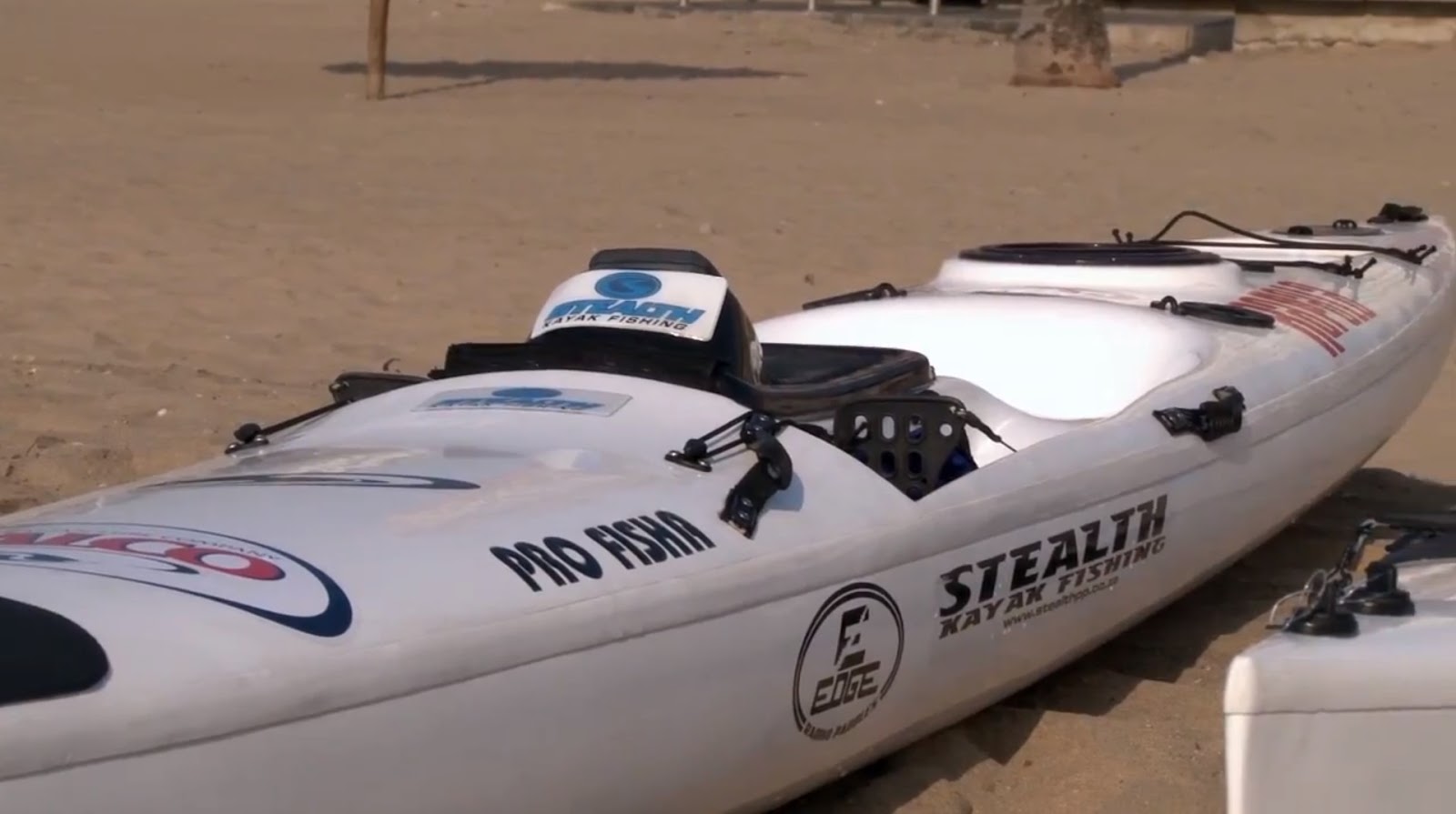
An excellent review and analysis by Brett Challenor using a Garmin GPS unit of the three Pro Fisha kayaks from Stealth.
As you would expect, the mighty 575 is the quickest, averaging 11km/h! That's damn quick for a fishing kayak but I suspect it might not be so easy if you're not a top paddler like Brett...
But the "big guy yak" 525 isn't that far behind at 10km/h. This yak has a lot more buoyancy and stability, as tested by the well-muscled chap above (a good 30kg heavier than Brett!).
The shortest yak in the range (but still respectable) 475 managed an average speed of equivalent to the 525. So what you gain in length doesn't really offset the greater stability needs of the 525. Very interesting read. Very impressed with my 575, it's the quickest fishing kayak I've ever paddled and as a dedicated platform it's not really missing anything that I need. I'm not in any way affiliated with Stealth, but I really think the Pro Fisha 575 is great product and I'm happy to spread the word!
Showing posts with label Sea kayaking. Show all posts
Tuesday, 16 July 2013
Thursday, 9 May 2013
The Stealth Pro Fisha 575: first impressions in the wet
So, the day finally arrived with almost no wind, bright sun and Bank holiday to boot, meaning I got the chance to dip my new Stealth Pro Fisha 575 in the sea for the first time.
Before I start this "wet first impressions", I must say that I'm constantly surprised at how light such a long SOT kayak is, the boat is over a metre longer than a Scupper Pro but weighs less. I can lift it on and off the car without a problem with regards to the weight, but its length is another thing. The yak is so light and long that when the wind catches it on your shoulder it can easily catch you off guard, and once something so long starts to swing it can take a bit of stopping!
I had spent weeks rehearsing how my various paraphernalia would fit in or on the Pro Fisha 575. The 575 has a truly cavernous interior, accessed by a huge front hatch. However, this is not quite as large as you first think. For example, a C-Tug has to broken down to get it into the hatch. But because the space in there is so big, I decided I could fit my C-Tug, my insulated fish bag and my tackle boxes all inside the hatch! This does work, but it means that if you want to squeeze your rods in to go through the surf, you might find it difficult to get them past all the various bags.
First thing you are made aware of is the presence of the rudder. This means you can't easily put the kayak down on tarmac or any hard surface, or at least if you do then it has to rest on its side. You'll notice this most if you try and land on concrete slip ways or pebble beaches, as you have to drag it on its side to avoid the rudder. Even on sand, you have to drag it on its side. Rods in their holders either fall out or go into the ground when it's on its side, the paddle will fall out of its clip and so on, and it doesn't somehow feel right to drag the yak up a concrete slip on its side... The on-land aspect of having a permanent rudder is the one thing I don't really like about the yak, I wish Stealth had thought about a retractable system, such as that found on the Epic V6.
Once on the water though it's a different story: the rudder is great. Almost no drag and very sensitive to careless adjustment by my unthinking feet! Indeed, for the first hour or so I struggled to remember which foot did what and not to casually push forward in my footrests to stretch my legs, then veer alarmingly to one side! I generally dislike flip down rudders, they add a noticeable drag which means you don't tend to want to use them and when you do need them they can be a major hassle, often jamming in position.
The Stealth 575's rudder has none of these issues, there's no drag and it's always there. It doesn't seem to catch the bottom even on very shallow landing sites. For someone who's been used to constantly correcting their direction using paddle strokes, having a good rudder was something of a revelation. You can just concentrate on your paddle strokes and let your feet correct your course. Love that!
Despite the length of the 575, I found I could spin it round with the same ease as my Scupper Pro, possibly even easier. I was very relieved to discover how manoeuvrable it was. It's quite impressive in that respect and it might have something to do with the boat having a more pronounced rocker than first meets the eye.
As a paddling vehicle, the 575 seems perhaps at the max about a third quicker than my Scupper Pro. That doesn't sound a lot, but it makes a massive difference when you want to get somewhere in a hurry. On several occasions I looked to see where my mate was before thinking "that'll take about ten minutes to get over there". But the 575 just eats up the metres once you get the speed up. I found that whereas with the Scupper Pro I quickly reached a sense of the maximum speed of the kayak, beyond which paddling harder doesn't make much sense, with the 575 there seems to be smooth progression that doesn't seem to top out at a maximum. The harder you paddle, the faster it seemed to want to go. When I paddled back to the launch with my mate in his Ocean Kayak Big Game, I was literally taking two or three strokes then waiting 10-15 secs for him to catch up! I'm really looking forward to trying the Pro Fisha 575 out on some of the long distance marks to get a better sense of how much better it is, particularly in rougher conditions. The conditions we had were practically windless at times, and so I didn't get any chance to test paddling across the direction of the swell, or with a following sea. I'll save those for a later report.
For me the biggest difference between the Pro Fisha 575 and my Scupper Pro was that the 575 is a far, far better fishing platform. In fact there's no comparison really, the Scupper Pro is horribly designed in terms of fishing space and layout, whereas the 575 is pretty much perfect. I've always been something of a minimalist, but the Scupper Pro was frankly a pain to gut fish on and store tackle securely - my fish bag had to be right behind me and I have lost a couple of fish from them slipping out of my grasp as I reached behind me, missing the opening of the bag and then having them slide off into the depths! The Pro Fisha 575 has everything there within easy reach, secure and protected beneath a hatch. That's a big improvement, and I'm sure I'll appreciate it even more when I come into land with a bit of surf. The only thing I didn't really like is the paddle clip, which barely holds the paddle in place. Don't fancy trusting that in rough water...
Fishing wise, it's still a bit early for clear water. The sea had that green murk we associate with the May Bloom, and generally it's a killer for the fishing. There was no sign of diving birds and everything looked pretty lifeless out there. I tried my new weedless rig fitted with the Fiiish Black Minnow 160. The rig worked pretty well, but on a fast drift 60g is just a bit on the light side and struggles to hold bottom. But the big issue I had was that I didn't make sure all hook points on the lures were well inserted into their soft plastic bodies. If you don't check this, they can work loose to expose the hook point and then snag up. Ouch! Nearly a tenner's worth left on the bottom! Didn't make that mistake twice and the rig managed to winkle out a couple of little coalies:
One thing you need to watch out even with a weedless rig is that flourocarbon is really pretty crap when it comes to abrasion resistance - I'm sure it's not as tough as something like Amnesia. After an hour or so, I noticed the section close to the Black Minnow was within a whisker of breaking:
But today was not about the fishing, it was all about a practice paddle in my new yak. The final thing to do was to try out some self rescues. We came right into the bay where the water was marginally warmer and shallower. It's still bloody cold - this is the North Sea after all! After watching Big Paddle's review and self rescue on the 575, I thought it looked pretty easy. He certainly made it look easy in his video! True, I had the Stealth Deluxe seat fitted, which does get in your way a little, but eventually I got the hang of it. I definitely need more practice though!
In summary, the Stealth Pro Fisha 575 is a brilliant fishing platform. It's a long, light, quick and responsive boat on the water. It may not have the agility of a smaller boat in the surf, but that's not something I generally ever need. It's eats up the kilometres with ease, and I've heard it actually performs better with a load of fish on board, so bring on those big catches of cod and mackerel in the summer months!
All in all, I'm really pleased with the kayak. It's everything I hoped it would be and some things I didn't think it would be!
Before I start this "wet first impressions", I must say that I'm constantly surprised at how light such a long SOT kayak is, the boat is over a metre longer than a Scupper Pro but weighs less. I can lift it on and off the car without a problem with regards to the weight, but its length is another thing. The yak is so light and long that when the wind catches it on your shoulder it can easily catch you off guard, and once something so long starts to swing it can take a bit of stopping!
I had spent weeks rehearsing how my various paraphernalia would fit in or on the Pro Fisha 575. The 575 has a truly cavernous interior, accessed by a huge front hatch. However, this is not quite as large as you first think. For example, a C-Tug has to broken down to get it into the hatch. But because the space in there is so big, I decided I could fit my C-Tug, my insulated fish bag and my tackle boxes all inside the hatch! This does work, but it means that if you want to squeeze your rods in to go through the surf, you might find it difficult to get them past all the various bags.
| Plastic bath tub vs. fibre-glass arrow! |
Once on the water though it's a different story: the rudder is great. Almost no drag and very sensitive to careless adjustment by my unthinking feet! Indeed, for the first hour or so I struggled to remember which foot did what and not to casually push forward in my footrests to stretch my legs, then veer alarmingly to one side! I generally dislike flip down rudders, they add a noticeable drag which means you don't tend to want to use them and when you do need them they can be a major hassle, often jamming in position.
The Stealth 575's rudder has none of these issues, there's no drag and it's always there. It doesn't seem to catch the bottom even on very shallow landing sites. For someone who's been used to constantly correcting their direction using paddle strokes, having a good rudder was something of a revelation. You can just concentrate on your paddle strokes and let your feet correct your course. Love that!
Despite the length of the 575, I found I could spin it round with the same ease as my Scupper Pro, possibly even easier. I was very relieved to discover how manoeuvrable it was. It's quite impressive in that respect and it might have something to do with the boat having a more pronounced rocker than first meets the eye.
As a paddling vehicle, the 575 seems perhaps at the max about a third quicker than my Scupper Pro. That doesn't sound a lot, but it makes a massive difference when you want to get somewhere in a hurry. On several occasions I looked to see where my mate was before thinking "that'll take about ten minutes to get over there". But the 575 just eats up the metres once you get the speed up. I found that whereas with the Scupper Pro I quickly reached a sense of the maximum speed of the kayak, beyond which paddling harder doesn't make much sense, with the 575 there seems to be smooth progression that doesn't seem to top out at a maximum. The harder you paddle, the faster it seemed to want to go. When I paddled back to the launch with my mate in his Ocean Kayak Big Game, I was literally taking two or three strokes then waiting 10-15 secs for him to catch up! I'm really looking forward to trying the Pro Fisha 575 out on some of the long distance marks to get a better sense of how much better it is, particularly in rougher conditions. The conditions we had were practically windless at times, and so I didn't get any chance to test paddling across the direction of the swell, or with a following sea. I'll save those for a later report.
For me the biggest difference between the Pro Fisha 575 and my Scupper Pro was that the 575 is a far, far better fishing platform. In fact there's no comparison really, the Scupper Pro is horribly designed in terms of fishing space and layout, whereas the 575 is pretty much perfect. I've always been something of a minimalist, but the Scupper Pro was frankly a pain to gut fish on and store tackle securely - my fish bag had to be right behind me and I have lost a couple of fish from them slipping out of my grasp as I reached behind me, missing the opening of the bag and then having them slide off into the depths! The Pro Fisha 575 has everything there within easy reach, secure and protected beneath a hatch. That's a big improvement, and I'm sure I'll appreciate it even more when I come into land with a bit of surf. The only thing I didn't really like is the paddle clip, which barely holds the paddle in place. Don't fancy trusting that in rough water...
| Perfect fishing platform, shame about the lack of fish! |
One thing you need to watch out even with a weedless rig is that flourocarbon is really pretty crap when it comes to abrasion resistance - I'm sure it's not as tough as something like Amnesia. After an hour or so, I noticed the section close to the Black Minnow was within a whisker of breaking:
But today was not about the fishing, it was all about a practice paddle in my new yak. The final thing to do was to try out some self rescues. We came right into the bay where the water was marginally warmer and shallower. It's still bloody cold - this is the North Sea after all! After watching Big Paddle's review and self rescue on the 575, I thought it looked pretty easy. He certainly made it look easy in his video! True, I had the Stealth Deluxe seat fitted, which does get in your way a little, but eventually I got the hang of it. I definitely need more practice though!
In summary, the Stealth Pro Fisha 575 is a brilliant fishing platform. It's a long, light, quick and responsive boat on the water. It may not have the agility of a smaller boat in the surf, but that's not something I generally ever need. It's eats up the kilometres with ease, and I've heard it actually performs better with a load of fish on board, so bring on those big catches of cod and mackerel in the summer months!
All in all, I'm really pleased with the kayak. It's everything I hoped it would be and some things I didn't think it would be!
Tuesday, 9 April 2013
The Stealth Pro Fisha 575: first impressions in the dry
Well, it finally arrived after what seemed months of waiting! Chris and Victoria pulled into our little street of tightly terraced houses to deliver my nearly 6m sea fishing kayak. First impressions?
First impressions are exactly that. What strikes you as you glance at it for the first time, which is generally the paint job and the profile. There's no doubt that the 575 has a fantastic looking profile, it just looks like it's built for speed. That very low profile back end sits low in the water, extending the waterline without catching the wind and I can't wait to try it out. Its hull is practically flat, which should make for good stability and surfing characteristics, and speed of course.
As for the paint job, well it's probably the only time you'll ever look it in such detail, in the months to come that nice shiny finish will soon be scratched and matted up all over with sand, gravel, fish guts and who knows what! But for the meantime it's absolutely pristine, which means that faults tend to show up more. Stealth are known for their sometimes wild and wacky colour schemes dreamt up by customers from all over the globe, which is great, but the more complicated and exotic the colour scheme, the more likely you'll see the odd error.
What else? Well, laying it on the world's smallest lawn gave me chance to go over some options on where to put stuff. Certainly the front hatch is cavernous, really enormous, and everything could just go in there. The South Africans seem to put their fish straight in the hatch, but I prefer to use a cool bag to store my catch so I can keep it really cold with freezer blocks. When I freeze mackerel, I like to see the colours still on them! A cool bag does restrict access to the space further up and below:
But you don't need access to it all the time, you can just keep a small opening and slide the fish in there, keeping your tackle boxes in front.
The next big item for me is my C-Tug. This won't fit in the back hatch at all, so it has to either go in the front or strapped to the back. You don't really want your C-Tug covered in mud / sand to go in with your tackle and fish, getting everything all mucked up. If you feel you can make it secure, the C-Tug fits quite nicely strapped on the back with the elastic cord. But it would need a roll test to make sure it doesn't come out if the yak turns over. The other point is that the rear of the 575 sits pretty low in the water, so it may be that the wheels will drag a little. I'll have to check that out on the water. The best place for it might be right up at the front. Extra weight there can help keep the nose down a little, which can marginally extend your waterline and so improve your speed.
Perhaps my biggest surprise are two factors that reflect the kayak's designers live in a warm water environment with sandy beaches. First, the Pro Fisha 575 has a permanent rudder, making it difficult to drag up rocky or shingle beaches using the front end handle. Stealth provide a "drag" handle, but that's not something you want to use if you're on rough ground as it just scrapes the side of the yak.
If you've already fitted your rudder, and you want to adjust your feeting position before you get on the water, you need to find somewhere with soft sand so that you don't risk buckling the rudder as the entire weight of you plus yak will be on it. Best to get your foot rests in the right place before you put the rudder on.
And speaking of feeting position, we come to the second feature that seems pretty typical of SA kayaks: tiny little footwells, suitable for bare feet or at best feet wearing just neoprene. Most UK guys paddle in cold water for most of the year, and if you're wearing boots on top of dry socks (i.e. from a dry suit, so a size up from your normal boot size) then you probably won't fit them into the Pro Fisha footwells. Bit annoying, as we don't all launch or land onto sandy beaches. Where I fish it can often be sharp barnacled rock edges on the shoreline. Not great for glass yaks, but even worse for neoprene socks. You need boots in these places, but my Orvis wading boots don't fit so I'm in the market for some new footwear. This seems to have been something that the Dorado 2 has addressed specifically, though the footwells are still pretty narrow in that boat too from what I hear. If you're a big guy, try your footwear out first in someone else's!
That's it for my first impressions. What really counts is it's performance on the water. If it's fast, comfortable and handles rough water, that will do for me. All other considerations are secondary!
But now I have it, the question is where do you put a six metre kayak? It'll have to go up the back wall like my Scupper Pro did, but this is over a metre longer... Imagine the neighbours fear and delight when they saw nearly six metres of kayak arrive ready to go up against our gable!
First thing is to get it on the wall, note the rubber fenders on the gable to protect the yak:
Next is to get the sophisticated and fully patented Vertical Yak Lifting End Protection Unit in place:
Then carefully lift it into position, nose down in the fully patented protection unit with one end resting on a wall buttress, and attach the pulley:
From outside it looks even more ridiculous. Remember the nose is about a foot from the corner of the house...
Next step is too walk along the kayak, holding it above your head, until it rears vertically up against the wall. I think you can forgive me if there are no photos of this part! Bit jittery the first time, but in the twinkle of an eye the job is done.
The kayak, all 5.75m of it, extending even above the roof line, is strapped securely in place!
Yes I know it's bonkers, I can't wait till we move house!
Coming next will be an on-the-water first impressions, stay subscribed for the updates!
First impressions are exactly that. What strikes you as you glance at it for the first time, which is generally the paint job and the profile. There's no doubt that the 575 has a fantastic looking profile, it just looks like it's built for speed. That very low profile back end sits low in the water, extending the waterline without catching the wind and I can't wait to try it out. Its hull is practically flat, which should make for good stability and surfing characteristics, and speed of course.
As for the paint job, well it's probably the only time you'll ever look it in such detail, in the months to come that nice shiny finish will soon be scratched and matted up all over with sand, gravel, fish guts and who knows what! But for the meantime it's absolutely pristine, which means that faults tend to show up more. Stealth are known for their sometimes wild and wacky colour schemes dreamt up by customers from all over the globe, which is great, but the more complicated and exotic the colour scheme, the more likely you'll see the odd error.
My 575 is white tipped with red. Pretty simple, but even this proved a bit difficult for the gel coat finishers at Stealth. One side the lines don't quite meet up at the binding strip and on another they meet up but one isn't straight. The bonding strip is also a bit wobbly on the edges and still spotted with the release agent from the mould, giving it a slightly ragged appearance. This is a shame, as the kayak is generally finished quite well and the fittings look good quality.
![]() |
| You might find some raggedy edges and the odd line that veers off from the vertical. |
As I say, the paint job will soon be scuffed, scratched and generally look a mess, so it's not really a big deal. It's just those first impressions. ;-)
What else? Well, laying it on the world's smallest lawn gave me chance to go over some options on where to put stuff. Certainly the front hatch is cavernous, really enormous, and everything could just go in there. The South Africans seem to put their fish straight in the hatch, but I prefer to use a cool bag to store my catch so I can keep it really cold with freezer blocks. When I freeze mackerel, I like to see the colours still on them! A cool bag does restrict access to the space further up and below:
But you don't need access to it all the time, you can just keep a small opening and slide the fish in there, keeping your tackle boxes in front.
The next big item for me is my C-Tug. This won't fit in the back hatch at all, so it has to either go in the front or strapped to the back. You don't really want your C-Tug covered in mud / sand to go in with your tackle and fish, getting everything all mucked up. If you feel you can make it secure, the C-Tug fits quite nicely strapped on the back with the elastic cord. But it would need a roll test to make sure it doesn't come out if the yak turns over. The other point is that the rear of the 575 sits pretty low in the water, so it may be that the wheels will drag a little. I'll have to check that out on the water. The best place for it might be right up at the front. Extra weight there can help keep the nose down a little, which can marginally extend your waterline and so improve your speed.
Perhaps my biggest surprise are two factors that reflect the kayak's designers live in a warm water environment with sandy beaches. First, the Pro Fisha 575 has a permanent rudder, making it difficult to drag up rocky or shingle beaches using the front end handle. Stealth provide a "drag" handle, but that's not something you want to use if you're on rough ground as it just scrapes the side of the yak.
If you've already fitted your rudder, and you want to adjust your feeting position before you get on the water, you need to find somewhere with soft sand so that you don't risk buckling the rudder as the entire weight of you plus yak will be on it. Best to get your foot rests in the right place before you put the rudder on.
And speaking of feeting position, we come to the second feature that seems pretty typical of SA kayaks: tiny little footwells, suitable for bare feet or at best feet wearing just neoprene. Most UK guys paddle in cold water for most of the year, and if you're wearing boots on top of dry socks (i.e. from a dry suit, so a size up from your normal boot size) then you probably won't fit them into the Pro Fisha footwells. Bit annoying, as we don't all launch or land onto sandy beaches. Where I fish it can often be sharp barnacled rock edges on the shoreline. Not great for glass yaks, but even worse for neoprene socks. You need boots in these places, but my Orvis wading boots don't fit so I'm in the market for some new footwear. This seems to have been something that the Dorado 2 has addressed specifically, though the footwells are still pretty narrow in that boat too from what I hear. If you're a big guy, try your footwear out first in someone else's!
That's it for my first impressions. What really counts is it's performance on the water. If it's fast, comfortable and handles rough water, that will do for me. All other considerations are secondary!
But now I have it, the question is where do you put a six metre kayak? It'll have to go up the back wall like my Scupper Pro did, but this is over a metre longer... Imagine the neighbours fear and delight when they saw nearly six metres of kayak arrive ready to go up against our gable!
First thing is to get it on the wall, note the rubber fenders on the gable to protect the yak:
Next is to get the sophisticated and fully patented Vertical Yak Lifting End Protection Unit in place:
Then carefully lift it into position, nose down in the fully patented protection unit with one end resting on a wall buttress, and attach the pulley:
From outside it looks even more ridiculous. Remember the nose is about a foot from the corner of the house...
Next step is too walk along the kayak, holding it above your head, until it rears vertically up against the wall. I think you can forgive me if there are no photos of this part! Bit jittery the first time, but in the twinkle of an eye the job is done.
The kayak, all 5.75m of it, extending even above the roof line, is strapped securely in place!
Yes I know it's bonkers, I can't wait till we move house!
Coming next will be an on-the-water first impressions, stay subscribed for the updates!
Friday, 22 March 2013
Sea kayaking or white water kayaking?
Sometimes the distinction doesn't seem to matter much, but this guy is using a sea kayak in British Columbia to ride stationary waves in some of the most turbulent sea water I've ever seen. This place just looks incredible - what a place, what a landscape, and what an opportunity!
Friday, 22 February 2013
VHF radios and sea kayak fishing PFDs
Now we have many things to be thankful to the Americans for, but just occasionally the size of their internal market means that the big global producers of kayaking clothing and equipment tend to focus on what will sell well for their American customers. In the case of kayaking PFDs, this means that the majority are designed for either for sit-in kayaks (meaning they have a low back), or inland sit-on tops (SOTs) kayaks, as high performance sea worthy SOTs remains something of a niche market in the US.
This means we have companies like Stolqhist and MTI producing angling PFDs that are intended principally for fly fishing on inland waters. Which is fine, but those products rarely transition well to sea kayak angling. For example, MTI like to place a lash tab right above their pockets, making it difficult to attach a handheld VHF unit there. This is not a problem if you are fishing inland lakes as you're unlikely to use a VHF radio.
However at sea, a handheld VHF unit is essential for safety and staying in contact with other boats in the area. Most VHF units come with a clip to attach to a lash tab, but the positioning of that tab must allow easy access to the radio. It should keep the radio close to your mouth, so that no bending down is needed to use it. Ideally - in extremis - a waterproof VHF unit should remain usable even if you're in the water and the positioning of the radio must not place the radio so low that it might catch or snag any rigging on your kayak if you need to attempt a re-entry.
![]() |
| Struggling to speak into a badly positioned VHF radio. The radio would be practically underwater if you took a spill. |
You want that VHF unit somewhere secure, well out of the way, preferably up near your collarbone where it won't catch on anything as you clamber on board. Unfortunately, designing PFDs to make it easy for SOT kayak users to easily re-enter their craft after a capsize doesn't appear to be high up on the agenda of most companies.
![]() |
| The Kokatat Bahia Tour has a lot of front bulk, made worse if you attach a VHF unit to point furthest from the body, where it hangs vertically making the aerial prone to catching things. |
![]() |
| The Kokatat Bahia Tour's single lash tab. How about giving us another one Kokatat? :-) |
Time for a change?
PFDs are made for many different aspects of kayaking. White water, touring, recreation and angling. In theory there are several top end sea touring PFDs (for example the Palm Kaikoura) that would be well-suited for sea kayak fishing, but unfortunately nearly all of them have low backs as their main markets are for sit-in sea kayaks, not SOTs. Low back PFDs are less comfortable to wear in the high-back seats that are commonly used with SOTs.In fact Palm are another case in point. While they have the well specified Palm Kaikoura as their top of the range touring PFD (shown below left), their high-back touring model suddenly comes down in specification (the Taupo, shown below right). Hmmm, no lash tabs at all on the Taupo? Nope, 'cos people who use high back PFDs don't need 'em!
| Pam Kaikoura: lash tabs in abundance... |
| Palm Taupo: hey, where'd the lash tabs go? |
The fact that SOT kayak users are considered second-class citizens in the kayaking world is understandable, as they came from a recreation background, i.e. they're not serious kayakers. But that view is rapidly becoming out of date and it's high time for a change in the manufacturers' thinking. These days, high performance glass and carbon fibre SOTs that are purpose built for angling are gradually getting more market share (with the exception of the US, where plastic remains king). These new kayaks are intended to be paddled long distances and are just the sort of craft that can take you well off-shore in conditions previously only tackled by sit-in sea kayaks. But even in the "plastic bath tubs" that many kayak anglers start off using, it is possible to get some distance off-shore and to experience challenging sea conditions. As kayak anglers, we really need PFDs to match our hobby's requirements and where we can now fish.
I'm not advocating "rough conditions" sea kayak angling, but do you want to be out there with a "recreational" PFD when conditions get bad? Is your emergency strobe visible? Can you quickly change channel on your VHF if asked to do so? Could you access it if you were turned overboard? Is there a D-ring that would assist you being winched up to a rescue helicopter?
When I'm fishing at sea in my kayak, my fishing buddy can be anything up to a mile away from me. Our VHF radios are always on, if the weather's a bit iffy then we're on channel 16 listening out for coastguard weather notices or warnings, but if the weather's fine we keep it on channel 12 and keep each other informed about what's happening via the radio. Things can change quickly when your at sea, not least the sudden appearance of fish! You need rapid easy communication with your fellow kayakers and any nearby boats, and a VHF radio is the essential piece of kit for sea kayak fishermen to do that.
My essential feature list for a sea kayak fishing PFD
- Front lash tab for VHF radio placed high up to facilitate frequent use and channel change.
- Lash tab preferably slightly angled to try and minimise VHF aerial from catching on things as you re-enter the kayak.
- Rear lash tab for emergency strobe light, positioned to be accessible over the shoulder.
- Solas reflective panels on front, back and top of shoulders.
- Big splash-proof front pockets.
- High back design, with plenty of ventilation for hot weather kayaking.
- Strong rear D-ring for rescue.
- Not too much front bulk.
You would think that feature list would be easy to find but it isn't! If you have any sea kayak fishing PFD recommendations or comments, please let me know.
Thursday, 7 February 2013
Interview with Brett Challenor of Stealth Kayaks, Part 2.
We come to the second part of our interview with Brett Challenor, founder and boss of Stealth Kayaks, South Africa (if you missed it, check out part one where we discuss more general aspects of kayak design). Once again we throw in a few questions from members of the Anglers Afloat forum.
In this part, Brett talks in detail about the new Pro Fisha range and how the kayak achieves its impressive strength to weight ratio. We discuss whether Stealth were influenced in the design of their fishing kayaks by the UK's best known high end fishing kayak, Kaskazi's Dorado. Brett has some surprising things to say about the Dorado's success in South Africa and talks about why he feels it was never designed from the outset as a fishing kayak. We discuss if there are height restrictions on the Pro Fisha and Brett reveals that Stealth have another model in the pipeline for the Pro Fisha range that will be designed specifically for bigger guys. We go over some of the options for fitting fish finders and other accessories such as tackle trays and bait boxes. Finally, we address that all important question of whether there's a need for a back rest in the Pro Fisha!
Part 2: The Pro Fisha Range
We've now got a few questions relating specifically to the Pro Fisha 475 and 575, because this range of kayaks seems to be generating a lot of buzz in the UK at the moment and I know there's a big container of both sizes coming over very shortly!Let's start with the design of the Pro Fisha. The rear of the Pro Fisha, especially the 575, looks to sit quite low in the water, how does that affect the yak catching the wind?
Not at all. Obviously the rear sitting a little low in the water has a got a lot to do with your weight distribution and also the rocker of the kayak and the volume of the tail. But in relation to the wind, that's not going to make a difference. What'll make a difference is the front or nose of the kayak into the wind, that's where you catch the wind, not from the back.
Does that mean when you're fishing you swing round with your back to the wind?
Yeah, you know, a Pro Fisha kayak, you'll always know that the kayak will sit tail down a little bit more?
That suits me, my Scupper Pro tends to sit side on to the wind and it can be annoying on occasions!
![]() |
| Nose up, sprinting to catch a wave on the Pro Fisha 575. |
Ah, that's very interesting. I had wondered about the change in weight distribution in the kayak once you start to add fish.
You've recently upgraded the design of the Pro Fisha range, was that after feedback from anglers?
No, we were always going to do that, but listen, we work on feedback flat out, I mean the more feedback we get from customers, the better. Fishing is really our hobby! We try to give guys what's best for them.
Why did you choose to upgrade the design of 575 before the 475? Seems like the 475 will appeal to a wider public...
The Pro Fisha range came from a range called the Fishas, which we were quite hybrid between fishing ski / surf ski and the longer the ski the faster it goes. So we thought, like, let's make one that goes as fast as possible, and that's where you need the length [for the 575, which increased in length]. So after that, we thought well, not everyone wants speed, some people want more manoeuvrability in the surf, and the 575 doesn't fit in their garage!
Common complaint over here too!
And that's where the 475 came about.
OK, we have a question from forum user jasondstub: How much faster is the 575 than the 475?
Fast? I don't know if fast is really the right word, because I can paddle the 475 as fast as 575. But to keep it going the same speed for a long period of time, I can't do that. So the 575 has a distinct advantage where once you get it up to 11 or 12 kph, then you keep it going at that speed, for.. let's say 20 minutes [ah hem! Don't try that at home kids, we're not all ex-pro racers!]. You can do that with the 475, but you could only do it... for, say 5 or 6 minutes. So it's more to do with the effort to keep that speed up that makes the difference.
![]() |
| The two Pro Fishas in action. Equally fast, but only over short distances! |
It is, because of its length. Obviously when you climb away in a longer kayak then there's obviously more kayak in front of you to come down and give you a little hull slap. But it depends on the conditions. If you get a wind where you get where there's what we call a "short chop", then the 575 will be better than the 475. But then you get what we call "long chop", then the 475 will be better, because obviously the gap changes between the waves.
In the UK, there seems to be only two main makes of high end fishing yaks, yourselves and Kaskazi. It's something of a running debate over here which is best...
Yes, there's been that debate between some of the guys in the export countries, between one or two of them there's been that debate. But it's also depends on what the guys are used to, eh?
Sure, I think Kaskazi also got over here a little earlier than yourselves...
...yes, yes.
...so they became established as a brand leader in the market over here?
Yeah, yeah. Well, unfortunately they don't even exist here [in South Africa], when I say they don't exist, you don't see them.
Really? That's... very, er... surprising! I'm really surprised by that...
I think they've actually done better in the international market than the domestic market. You just don't see them in the water here. I mean, in KZN where I'm from and where our factory is, if you saw one, you'd go "oh my goodness, what's that?"! KZN being the place where most people are kayak fishing, out of South Africa, that is.
That's really interesting, I mean.. they're the dominant, number one, top end yak over here...
We can change that, no problem!
OK. When you first considered the design of the Pro Fisha, did you keep in mind competitors such the Kaskazi? I guess you've answered this by saying Kaskazi is not a common a kayak in South Africa...
[laughs] Not at all! It's funny, you don't see it at all. We know that it's here, because of the guy in Cape Town who makes it. But we take what we've designed and try and improve it, rather than look at someone else's.
Really, you never looked at it? Never seen it?
Oh we've seen it. Probably the last time I saw one was two years ago. Do you know where the Dorado design actually came from?
No.
The Dorado was a sea touring kayak, made by a guy called Leon, from Cape Town with a company called Coastal Kayaks at Sea Point, and they used to do kayak tours, paddling around. I used to supply them with surf skis, and he got into a conversation with me one day, and asked about the fishing kayaks because there was a big market in KZN, and he asked me how we did the hatches, and blah, blah, and so on, and I told him because he said he wanted to make one, and he took his most successful touring kayak, and he stuck a hatch in it. And that was how the first Dorado was ever made.
OK, well, fair play to him!
Well it's only been tweaked slightly from there, so it's always been a touring kayak that's been adapted for fishing. It was never purpose made for fishing. He's obviously... with his demand from the overseas market he's fine tuned it in the last few years, but it was never designed originally for fishing.
Right, well it seems well liked over here, so I'm sure that'll start a debate!
OK, now a question from forum user fishboy: Is there any height restriction on the Pro Fisha range?
Er, you can only adjust the pedals up to a guy 6' 3" / 6' 4", it depends on how long the guys legs are, might be a little more.
Right, I've got a mate who's thinking of buying one, and he's 6' 4"!
Yeah, look it's easy to check. You can check when you're sitting and measuring your comfort of leg length. So you're sitting at the right angle,and you measure from your heels to the base of your back. That gives you a measurement and you can see if it'll fit.
Is that a measurement that someone could send you and you could see how it fits?
If a guy gives me his inner leg measurement and his hip (from his ball joint) to the floor, I can do a cross check for him. No problem.
There is actually a third Pro Fisha model to be launched at the end of this year, which is due to be an in-between model, between the 475 and the 575 in length, designed for the really big guys who are quite heavy, and they're a bit tentative on the Pro Fisha range, and they want a little bit more stability, bit more volume. We're still playing around with the design on the computer at the moment.
The Pro Fisha seems extremely lightweight, even compared to carbon fibre yaks. Is there a risk that it's a weaker yak compared to heavier models?
No, I think I answered that one for you...
So, the Evolution and the Pro Fisha, you're going to say they've got the same strength and robustness?
No. The Pro Fisha's stronger.
Really? That's incredible, given that the Pro Fisha is 5kg to 6kg lighter for the same length than the Evolution?
Yep. We were having a conversation about this the other day, that the strength of the Pro Fisha compared to the Evolution is quite remarkable, purely from the resin systems and what we're using. It's got its downside, it's more expensive, but it is really strong. We haven't had any major problems, or even anyone who's managed to put a hole in one yet! We've had damage like gelcoat, from a guy going over the rocks, but we haven't had any issues as yet with the strength of the kayak.
Could you explain a little about the manufacturing of the Pro Fisha, and what separates it from other glass yaks?
![]() |
| Seating well CAD image showing front hatch |
![]() |
| The kayak is designed using CAD software, which then creates cutting templates for the CNC machine. |
![]() |
| CNC machine in action. |
Basically there's three parts to that kayak. There's a top, a bottom, and the fish box. You turn the fish box upside down and join it to the top deck of the boat. It's glued and fibreglassed on the outside, so you can't see it from the inside, but it's done from the outside before you close the kayak and you join the two pieces together.
All that bit is completely watertight?
Er, it's never completely watertight but generally it's 95%. It's fibreglassed around and there's a sealing layer on top, we've never had an issue of it leaking through there.
You can imagine... the remains of fish leaking into the inside of the kayak..!
Yeah it happens occasionally, but generally from a guy getting a crack in his hatch or something, never from just normal use.
How easy is to rinse and clean the fish hatch?
Oh, easy. You put a hose in there, rinse it, pull the plug and drain the water and you're done.
![]() |
| Fish box going into a Pro Fisha with the supporting foam stringer underneath. |
[laughs] Never! The tackle tray fits on the Supalite range, because it's got a flat deck, so it's easy to do two rails and a sliding tray tackle system. Whereas the Pro Fisha's got a curved deck and a raised profile in front of the hatch, so it's pretty difficult to get something to fit that and work easily.
Another question from jasondstub: does the fibreglass box that comes with it also fit the front hatch?
Yes, it fits both. [this question seems to have been misunderstood / been confused with something else- the fibreglass bait box (later referred to by Brett as "aaaah, the dreaded box..."!) is no longer made as they had some issues with it, but they're planning on making something similar to be released in about 4 months time - follow up email from Brett]
![]() |
| Sorry guys, this was an early prototype that didn't work out. |
We have a live bait torpedeo that we sell, that clips on the side, and you hang over the side of the kayak. We have the collapsible buckets, then one of the guys who works for me has come up with converting his bait box into a live bait box that runs off a foot pump. It runs off a whale foot pump, and you put the whale pump under your heel, there's a pipe in the water there, and one that runs to your live bait box, and while your paddle you give a pump every now and then with your foot and it recycles the water as you paddle.
Nice idea. Many anglers like to add fish finders & transducers, GPS units, etc. How easy is it to do this with the Pro Fisha?
It's very easy. All the kayaks that we're sending over [to the UK] have a battery box fitted inside the hatch. It's a little box that you can put a small battery on, so it's a shelf with velcro, so the battery's out of the way. When you unscrew it you have access to the hull of the kayak. The fish finder's tranducer you can now mount to the hull of the kayak. It shoots through the hull of the kayak no problem. You keep all your excess cable there, and then obviously just run the cable behind the battery box and you mount the finder on the lid of the hatch.
| Flush mounted lid for a fish finder - ideal for keeping its plugs protected from spray. |
So how would anglers get that? Is that something they can order from you?
Yeah, or you could ask Chris [Alers - the UK agent] for it. It's called a flush-mounted fish finder lid. On our website, er, our accessories page is... non existent!
I had noticed...
Yeah, we're busy revamping the website, especially the accessories to make it more of an information portal. So let's say you've got a livebait tube on the accessories, they'll be a YouTube video on how to use it, and photos to click on, so that's what we're trying to do.
Who came up with the idea of the rod rack in the hatch?
We did, because we were worried about getting fish slime all over our reels! That's one of the reasons, well, in the Evolution range, what you call your rod chute is from the top to the bottom. My idea, when I discussed it with my dad, is that all that space above where your rods go is just wasted. So, using all this fibreglass, that's heavy, and it's wasted. So I said that maybe we should make the hatch curve up, and put the rods up, then underneath we can put the polystyrene foam as your stringer, which as I was explaining earlier gives your buoyancy and strength, so you get the same strength, like a... strengthener system, and then what would be nice if you put a little rack in there it would keep your rods up, out of the way. Thinking out of the box, as they say!
![]() |
| Rod rack bar inside the the front hatch. Keeps your rods safe and your reel free of fish slime. |
Yes, it is. One of the key factors is that your feet are lower than your bum. You can sit with your feet lower than your bum all day. As soon as you raise your feet, your back will take some strain. So you'll obviously need support. Yes, backrests do make the kayak more comfortable, it definitely does, and we've got several types.
Forum user wild321 wants to know why a back rest doesn’t come as standard with the kayak?
Purely because not everyone wants the same backrest. And we've found that the kayak is comfortable enough not to use a backrest, but it's something you can add afterwards if you want to.
Really, so there are quite a few people who don't use them at all?
Er, you probably see 2 backrests to 7 without in South Africa, elsewhere maybe 4 to 10. So 4 will have backrests and 6 won't.
![]() |
| A couple of the seating options available from Stealth. You can see more info here. |
Tough question! Right now, for the type of fishing that I'm doing... I like to use the 475, for the ease of being able use it before work, it's so easy to load it on and off the car on my own when I'm fishing before or after work. But I love the 575 for the speed, and I just love the bigger kayak. If I'm fishing with someone, then it's the 575 every time. But it is just that little bit bigger when I'm on my own, and the 475 is a little bit easier to handle and manage. It's a toss up.
Oh no, I generally fish on my own and I've ordered the 575!!
No, you'll be fine, I promise you! I've been using a 575 for over a year now with no problems at all. But as I have the option to use something that's a little lighter when I'm on my own, then I'll take it just because it's there. But I wouldn't sacrifice the speed of the bigger boat, I can pull lures more comfortably, and I love the relaxed paddling of the bigger boat. Yeah, there's a lot more pluses for me with the 575 than the 475, but the 475 is more about convenience at the moment.
OK Brett, thank you so much for the taking the time out to do this interview. I'm sure it'll make fascinating reading for anyone thinking of purchasing a fibreglass fishing kayak, and a Stealth kayak in particular.
No problem, no problem at all.
Part 2 end.
Well folks, I hope you enjoyed that! It was fascinating talking to a guy who not only really knows his way around kayak design having raced professionally, but who is also a committed kayak fisherman. I'm sure some of his comments about the design of Stealth kayaks will provoke further discussion. Whatever people think ends up being the best kayak to fish from in UK waters, having a major kayak builder like Stealth entering our market can only be good thing for all us!
Please leave me any comments you have about the interview.
Thursday, 31 January 2013
Interview with Brett Challenor of Stealth Kayaks, South Africa.
Part 1.
Finally here is the long awaited interview with Brett Challenor, the guy responsible for the new Pro Fisha 475 from Stealth Kayaks, a super lightweight purpose-built fishing kayak that's generating a lot of excitement here in the UK, with the first container load due to arrive on these shores in March.
As someone who's just ordered the big daddy of the range, the 575, I had a whole bunch of questions I was dying to ask about Stealth's design philosophy, but I wanted to reach out to others who might have more general questions about fibreglass kayaks and their design, so I threw it out there for contributions from the Angler's Afloat forum. Naturally they were only too happy to contribute! We begin by finding out a little bit about Brett's background, how Stealth was formed and where the company is now.
| Brett showing off with another tiddler. |
Stealth was started over 17 years ago when I was working in my fathers boat building factory. He has been a fibreglasser and boat builder since he was 16 and is now almost 50 years in the business. At the time I was racing competitively in the lifesaving arena, competing in Australia and racing for South Africa. It was too expensive to import my own racing surf ski from Australia, so I thought why not make it myself and so Stealth was born. I went over to Australia and learnt how to build racing surf skis by working in a factory there for 3 months.
I then returned home and started my dream. For the first three to four years I only made one type of racing ski. Because I was racing for South Africa and winning a lot of the races, the business was easy as everyone wants the winning craft if you know what I mean. A few years later my Dad sold out of his boat building factory and joined me in the development and growth of Stealth performance products. We branched out into the fishing market and have never looked back. My Dad and I are now a great team, with his years and years of fibreglass experience and my understanding of what makes a ski work and perform, we now design and develop all our craft on CAD and then cut prototypes on a CNC machine followed by accurate plugs and end products. I think we now make possibly the world's finest fibreglass fishing kayaks.
For most kayak anglers in the UK, cost has always been a barrier and most start out with cheaper, plastic kayaks. What advantages could you expect when upgrading to fibreglass from plastic?
Look, er, I'll give you a breakdown. When we started first started exporting to Australia we had a very similar thing. Especially as one or two brands are made over there, but what the guys quickly worked out is that, and it takes a bit of time, is that a fibreglass kayak, a fishing kayak, has been designed as a fishing kayak and it has hatches for a reason. Things are put in a place because functionally that's what we find is the best thing for the kayak. Whereas the majority of your plastic kayaks are recreational kayaks, for paddling down a river or whatever...
Yeah, ok, let's say I've got a dedicated plastic fishing kayak...
Recently the plastic kayak manufacturers have started to realise how big the fishing market is and have started to produce some specific designs for fishing. But they're not really what the guys need and use here in South Africa, where we have so many different launches. Here you might see one plastic kayak to every forty fibreglass kayaks.
But why is that? Is it just a performance factor?
Yeah, it's like riding a road race on a mountain bike. You'd like to be competitive, but you can't, if you know what I'm saying. You'll never get a plastic kayak to perform like a glass kayak. You've got a lot of glide with a glass kayak. It glides, it keeps going. A plastic yak stops when you stop. It's a lot harder to paddle. If you spend 5 hours on the water, and you paddle a glass kayak you'll be tired. If you paddle a plastic kayak for that time you'll probably need to sit down and rest for an hour! That's sort of along the lines to what we've always said. There is a market for a plastic kayak, but the guys who are looking for the performance, for kayaks that are easier to paddle, easier to manoeuvre, bit more customisable, glass is way ahead of plastic.
Nothing really, you've obviously got to look after it a little better than a plastic one.
Well that leads to the next question, which is how durable is glass?
The way we make them these days, it's very durable. We had a customer who came in today, landed on the rocks, and it was just what we call a gelcoat (the colour). We just had to sand that back, respray it and polish it. It looks the same again. The technology that we've developed with the Pro Fishas is so advanced that we can make a really strong kayak, but it's also really light. So the durability is very, very good.
What about UV damage? Is there any susceptibility for fibreglass?
Er, no. Fibreglass will fade in time. But if you want to compare fibreglass to plastic in terms of UV damage, I honestly believe if you left a plastic kayak in the sun it would do more damage to a plastic kayak over time than it would to fibreglass one. Plastic starts to get brittle and takes a bit of strain.
OK, I've got a question from forum user andym: Can glass be repaired easily or does it need to be taken to a specialist?
It can be repaired very, very easily. Fibreglass is just a piece of material, you put what we call resin on it, and it's a patch like that. It's very simple. Obviously the specialists get you a very good finish. It's bit like a dent in your car. You can panel beat it, but you can't hide the dent. The specialists can do that and get you a really good finish.
How customisable are glass yaks?
They are very customisable within the realms of what you've designed, for example in our case with Pro Fishas we've obviously developed and designed what we know has worked with our customers, whether that be offshore or locally. There are certain things you can do, but the majority of it needs to be done when it's manufactured and not afterwards. I'm talking about extra handles and things like that. You know, you need aluminium paper, something sort of strengthening, something strong. Otherwise if you just put a hole in it for a handle in the kayak, it will eventually pull out, as the glass is thin. But plastic is just the same. Look, if you're putting rod holders, things like that, there's no problem because you're cutting a hole. It's just if you're putting in screws, things like that [that require strength].
A kayak can’t be all things to all men. What are the essential trade-offs in kayak design?
Mmm, that's quite a debatable topic! In our case, if you want a kayak that has speed, or you want a kayak that rides a wave better, or you want a kayak that's really stable, you can't put all that in one kayak. No matter what you do, you can't. That's why, I think, that's what we've done with the 575, the long kayak, and that's what we call the speed machine. Because in kayaking, the longer the kayak, the faster it goes...
![]() |
| Plenty of waterline makes for a fast kayak. |
Your waterline length. The more boat you have in the water, the easier it is to keep it going. You look at those racing powerboats, they're all long and thin. You know, the more waterline they can get in, the faster it can go. But then obviously you've got to have enough rocker design in them so that they go over the waves and doesn't plough through them. So what we did then with the 475, is say our customer there isn't looking for flat out speed, he wants slight better performance as well as the speed, so all we did was we shrunk the kayak and gave it a little more rocker, and that allowed the kayak to surf the waves better, didn't sacrifice the speed. Shorter the kayak, easier it is to turn.
That's why you see a lot of very short, plastic surf kayaks?
And that's why you see a lot of short plastics, as they don't have a rudder, so you put your paddle in and turn it. When it goes longer, the paddle can't turn and that's when you need to start putting rudders on.
You produce several designs for different conditions, could you go through the range for me and explain the thinking behind them?
Sure no problem. The Supalite was the first ever range of kayaks we ever designed. I started making those in 1998. It developed from an old life saving rescue craft, where it's wide and flat, and we used to lay a patient on the front when you rescue them.
Oh wow, fantastic!
[laughs] And when we were bored, we used to take our fishing rods and go fishing!
Excellent...
And then we realised we needed somewhere to hide our fishing rods, because launching through the surf in South Africa you need to protect your fishing rods, so then we put hatch inside it, and that traditional shape stayed, purely because that shape can really surf a wave. Our Supalite, I can surf that kayak pretty much like a surf board, it's got that shape. The downside is that it's a bit slow, it's a bit like a plastic kayak, it's hard to keep it going, and it's hard to paddle, but the advantage is that it's got a rudder system, it can turn and surf a wave very nicely, it's got steering and you can control it. The three kayaks in that range are obviously purely by size of person.
So what was the next kayak after the Supalites?
After the Supalites, we came up with the Evolution range. We wanted a slightly faster to paddle kayak. That's where I put my knowledge of surf ski racing in, and said well, let's try and combine the stability of a fishing kayak with the instability of surf ski, and give it the same sort of design so that it paddles fast and that it's easy and everything. And we did that with the Evolution range, we made a much faster paddling kayak that has all the stability, all the features of a Supalite.
| The popular Evolution 465, kitted up and ready to go. |
So it started out as a kind of minimalist fishing kayak?
Yeah! And it worked. We had a lot of guys in Australia who were buying them. And then, we found there were some guys who said "I don't want to use it as I want to take more than one rod". So then we took a step back, and said maybe we should design a fishing ski that's got the speed of a surf ski, the stability of a fishing ski, it's got a small hatch which is enough to take what you want, but which is made out of above average materials that keeps its weight down. Which is pretty much what we did. We converted what the Fisha range was, into something with an extra hatch in with a rod shoot that goes up to keep the weight down, and then we used the CNC machine and our CNC technology to design the kayak as light as possible. As I say, not too expensive, without using really expensive materials, but unfortunately to keep the weight down we had to convert to resins, like epoxy resins and specific core materials. And that's really where the Pro Fisha came from.
![]() |
| The new Pro Fisha. |
The epoxy resin we use is obviously way way stronger than a polyester resin. It's just a little more difficult to work with, but the process that we've developed allows us to use it, so you get a far stronger resin system. And obviously the fibreglass that we're using, we've upped that a bit, the specific core materials that we've imported, that we use within that kayak to keep the weight down make it very, very strong. That's basically how that design came about.
Did you intend this range of different kayaks to be generic across the world or are they specific to South African conditions and launches?
Er, well I came from spending a lot of my time overseas racing, when I was racing for South Africa, so from being a paddler. And I developed the business from a business that targeted [kayak] racing products, to a business that was more recreational, and obviously kayak fishing. I realised that if you're going to make fishing kayaks... the Supalite range is a wonderful range for South Africa, but it doesn't suit the overseas market because they're not taking on the surf like we do everyday. There, the sea stands up and the guys don't want to go kayak fishing! Australia's exactly the same, there the guys try and find as protected a launch as possible.
That's exactly what we do in the UK as well...
Yeah, so we realised we needed to find a range that suited our overseas market as well, and that we obviously identified that the Evolution range needed to be just a bit lighter, bit more manageable as well, leading to the Pro Fisha.
Once you're past the first few breakers, what helps a kayak handle a rough sea?
Obviously your stability is your biggest factor...
What about hull shape?
Yes the hull shape, you've got to have a really nice flat area underneath. Then what we call your rails, or the edges of your kayak, where it turns up towards to the sides. If you can roll your rails, that's the terminology we use, it gives you a lot more stability. The sharper your rails are, if you have a sharp rail, what it'll give is, you think it's more stable, but it's false sense of stability. What I'm trying to say with a very sharp rail, once you go over the edge, it'll turn over very easily.
It's the loss of secondary stability?
Yes, it's like balancing a box. If you go over that edge, the box will fall over. If it has rounded corners you can right it to the middle again.
What about length, is that factor in rough seas? Advantage or disadvantage?
The length is more your speed. In a very big big wind, a shorter kayak will be easier to turn around in the wind, but the longer will have extra speed, so it'll be easier to paddle into the wind and keep it going if you need to, so it's a trade off, it really depends on the conditions.
What does rocker mean and what's it's significance to yak design?
The rocker is the banana shape. If you put a pen on the table, and it's got no rocker, both the front and back of the pen touch the table. If you bend the pen, so that the ends point upwards towards the sky, that's what we call the rocker.
![]() |
| Rocker design in practice: punch through or go over? |
The rocker gives you the ability to surf a wave a lot easier. If you come down a wave, a kayak with more rocker means that the tail can dig in more, and the nose can lift easier, which means you can use the rudder to steer it a lot easier. Whereas with a longer kayak, you've got to have a little more speed to be able to turn it like a shorter one.
Does it affect how easy it makes the yak to paddle into waves from an oncoming wind?
Yes. When you launching in the surf, the kayak with more rocker will climb over a wave easier, even a broken wave, OK? Whereas with less rocker, you'll sort of punch through it more. When you're on the back line, on the outside of the wave, where the wave has finished breaking, the longer kayak will be easier because it gets over the wave with a little more speed, whereas the shorter kayak will climb and drop in, climb and drop in.
![]() |
| Longer kayaks tend to keep their speed better going over waves. |
Have you ever tried to turn a kayak with a retractable rudder quickly?
Er, no!
[laughs] It doesn't! With us launching in the surf and having the conditions and stuff, your optimal position of the rudder needs to be a little bit forward from the back of kayak to turn the kayak more efficiently.
Ah, so bringing it forward let's you turn more effectively?
Yes, equally if you're climbing a wave, OK, your rudder's right in the back. As you're going down a wave, if your rudder's right at the back of the kayak, your rudder's out of the water, it's ineffective. If your rudders in the water and you go down a wave, you can still turn and keep control of the kayak.
![]() |
| Staying in control, using your rails, rudder and paddle. |
Yes, exactly. It's about keeping the rudder in the water as long as possible, to keep control and handle the kayak. Yes, those retractable rudders, if you're going over rocks they're an advantage, but that's about the only advantage. We use a very thick stainless steel shaft, so to break or bend it you've got to hit it pretty hard, and equally if you do bend it you can bend it back. It's not a major problem.
Right, well, we had a lot questions along that theme. Is there any risk of it breaking by getting caught on rocks as you land?
You've got to hit the rocks pretty hard. You might bend it, slightly. Like you might bend a retractable rudder. But's it's nothing you can't bend back, or you can't straighten or manipulate it, if you like.
Not really. Your anchor rope's got to be thinner than where that rudder touches the hull, so it's got to get jammed in between them. I mean the shape of the rudder, I mean if you ride over a rope, it'll follow the shape of the rudder and then drop off the back, it won't get stuck.
OK, it won't get caught. How important is seating position for stability? Is the higher position a good trade off with it being a better fishing platform?
It's very important. The higher you sit, the more unstable it is. You need to sit as low as you can for stability, but equally it's got to be comfortable.
![]() |
| Stability shouldn't mean you have to compromise on your fishing positions. |
Yes, exactly, the lower the seating the more stable the kayak. But it's also in the design of the kayak if you know what I'm saying. The design and the height of your seat will give you your stability. The widest point of your kayak, where you put that in relation to the depth of your seat, will give you your stability. A slightly narrower or more unstable boat, if you can drop the seat lower you'll get more stability just from dropping the seat. But you can't make the seat the same height as your feet, as that's like sitting on something flat, you actually need to have your feet slightly lower than your bum, and it's a lot more comfortable that way. That makes a big, big difference!
Yeah, absolutely! Is the higher position a trade off with making it a better fishing platform? One of the criticisms of the Dorado is that because you're so sunk into the kayak, it's hard to fish side saddle.
Exactly. We think the seat in ours is an optimal height. You're not so sunk into the kayak you can't change position and fish side saddle with your legs over the side.
End of Part 1.
Subscribe to:
Posts (Atom)